
Notes on Christianity

The Hebrew Bible does not have a notion of resurrection. When people die their souls survive and enter a shadow world, Sheol, from which they can communicate with the living. Sheol is the Jewish state of the dead. It could mean the grave or another dimension. Later, Jewish mythology evolved to include the notion that there will come a future time when the righteous will be resurrected, but this is not original to the ancient religion (but it explains all the bone collections – those unique stone boxes full of bones). The notion of Hell as understood in Christianity, Gehenna or Hades, where the soul and body suffer everlasting torment and destruction, albeit sometimes also denoting the concept of Sheol or Hades as the abode of the dead, is not of ancient Jewish origin. Moreover, in the Old Testament, Satan was one of God’s archangels (of which there were many and many other lesser angels). Satan resided in the celestial dimension with God and was deployed by God to test the faith of his followers, sort of a celestial prosecutor.

In the late Old Testament and intertestamental period, between late sixth century BC and the first century AD, Jews came under the influence of Persian culture (when Persia conquered the Babylonians in 536 BC) and were influenced by Zoroastrianism, which conceived of the universe – and the soul – as containing opposing forces of good and evil, or cosmic / moral dualism. The evil force opposed God’s creative force, polluting / corrupting God’s pure creative work, hence aging, sickness, etc. There are two paths you can go by: the righteous path, which is the stairway to Heaven and happiness everlasting, and the wicked path, which leads to wretchedness and eternal torment in Hell. Zoroastrians are optimistic that evil will finally be vanquished and humanity will realize Paradise on Earth (they became more optimistic as the religion evolved, but I digress).

Under this influence, Jewish cults emerged that re-conceptualized Satan as the personification of evil. Satan is no longer tempting man as God’s prosecutor to test for loyalty (as we see in Job), but enticing man to sin for his own sake. He becomes the corrupter of men’s souls. In the emerging cultish version of Jewish cosmology, God (and his angels) and Satan (and his demons) become independent forces, locked in a struggle for power.

Christian mythology takes this further: Satan, an archangel is depicted as rebelling against god in the celestial realm. God casts Satan out of Heaven. Satan falls towards Earth (although it’s unclear whether all the way). Jesus, another of God’s archangels, is sent from Heaven, eventually depicted as God incarnate, representing along the way the fulfillment of a revised Jewish prophecy, repurposed to wash away the stain of sin with his purifying magic blood. The idea of choice, central to Zoroastrianism, where one chooses to be good, is incorporated into Christian doctrine, producing a more agency-driven religious feel (and an early source of the coming fascination with individualism); a person accepts Jesus as his personal savior, honoring the sacrifice Jesus made, in order to be welcomed into Paradise, now removed from Earth to Heaven. Jesus, one of many savior deities, thus represents a composite myth, and is subsequently historicized via the Gospels, which are written in the second century AD.

This is confirmed by the epistles of Paul, which are the earliest references to Jesus in history, penned well after Jesus is supposed to have lived. Paul insists that he has no personal knowledge of Jesus, that scripture and revelations are the only ways to knows Jesus. It came to him in a vision (although he consorted with other wizards of his sort). Jesus is not connected to human history in any of Paul’s writings. All of the elements in the Gospels, written many decades after Paul, are not in Paul’s epistles: Mary and Joseph, the immaculate conception, the virgin birth, the time and place of the birth, the manger and three three kings, Jesus’ childhood, John the Baptist, Jesus’ baptism, the temptation, sermons, parables, and moral pronouncements, exorcisms, healings, and miracles, the last supper, Judas’ betrayal, Peter’s denial, Jesus’ arrest and trial, the witnesses at the tomb, the transfiguration – none of these things are known to Paul (for they had not yet been invented). Paul only knows about crucifixion, burial, resurrection, and ascension, and some vague notion of the sperm of David (which translates much like God’s manufacture of Adam) and it is not clear that any of these things even happened on Earth. They seem to have happened in the celestial space between the Earth and the Moon where God and Satan do battle.

In Paul’s story, Jesus is an archangel, a salvation deity, sent from Heaven for the sake of people. Decades later there is a dispute among Christians as to whether that’s for Jews and Jewish converts, i.e. Torah observant Christians (TOCs), specifically, which ties in with the entirely speculative historical case of Jesus as a rebel seeking salvation from Roman occupation, or for Gentiles, too, for a we-are-the-world go at things. That latter bit really caught on, as you can see. Or, more accurately, with elaborated and forced on populations by law and by sword, thanks to the Romans. However, the only recipients of Jesus’ message, according to Paul, are apostles like Paul, that is, recipients of revelations from celestial quarters (albeit not in the detailed ways Muhammad and Joseph Smith were informed by Gabriel and Moroni). The ritual of the Eucharist is transmitted to Paul in the same way God transmits to Moses the building of altars (that “Don’t let me see your testicles” bit). It is not conveyed to him or by him as symbolic of an actual historical moment (which had yet to be invented).

The Gospels, written much later, attempt to situate Jesus in history, but even here the stories take the form of the Greek myths that purport to report events happening on earth. Indeed, when people read the Gospels as history they are missing the fact that they are myths telling parables about spiritual matters (such as the story of Jesus and the fig tree in Mark 11:13). Thus the Gospels are instances of contemporary myth-making in the same way that Joseph Smith manufactured the Book of Mormon. And very much in the spirit with the Jewish tribes and all, which either Smith accidentally picked up or he was smarter that we think). And just as the Book of Mormon is a plagiarism of the Biblical text, so the New Testament is a plagiarism of the Old Testament, and the Quran is a plagiarism of both the Old and the New Testament – as they were known at that time.

So, the New Testament is a mix of Paul’s epistles, second century AD myth-making and plagiarism, and forgeries (such as 2 Peter). Moreover, the extra-biblical sources claim knowledge of Jesus either only have knowledge of the cult or are themselves forgeries. Jesus is not actual historical figure. He is myth through and through.
Resisting the Politics of Offense Taking

The foundation of a concrete form of gender categorization could be challenged in such a way that the basis for a particular gender identity could seem problematic and the legitimacy of the associated political project threatened. Complaints about the critique could be framed as bias and hate. For example, questions raised recently by a feminist concerning the character of the gender construct led to her being labeled “transphobic.” Imagine using her article in a classroom on gender issues to provoke discussion. Transgender students could bring a complaint that transphobic ideas were being taught in the classroom, that they felt intimidated or threatened by the feminist’s critique, and the administration could, instead of educating the students about the rights and importance of academic freedom, flip the complaint switch and set the disciplinary machinery in motion. Even the possibility that this could happen could lead to the teacher not including that article and thus depriving the class of an important discussion.

A critique could be made of the claim that essentialist notions of race form the basis of expression of racial identity. Such a critique could be said to be offensive because it suggests the possibility of plausibly denying the reality of constitutional differences and thus the power of interpretation to efface a concrete and politically-useful meaning of race. Consider an argument positing that race is a sociohistorical construction and that, even when used as the basis of a politics by historically-disadvantaged group, it’s function is to reify race and maintain an artificial separation of people that harms the groups who are using it in struggle, calling into question the efficacy and thus the legitimacy of their politics. Students could claim that this critique felt harassing and threatening in that it had direct bearing on their racial identity and practice. They felt called out by the reading and lecture. They felt intimidated by the materials and were afraid to speak to them. But why shouldn’t this frank and searching critique be pursued in a classroom?

A criticism of a religious ideology that compels parents to cut the genitalia of their male offspring in a way that reduces their experience of sexual pleasure and marks them as a member of a group expressing beliefs to which they did not voluntarily subscribe and will suffer consequences for rejecting (which won’t bring back their foreskin in any case) could be perceived as an attack on the identity and deeply-held beliefs of more than a billion people. Or suppose a critique made of modesty rules, such as the wearing of restrictive clothing. The complaint would be that these beliefs and practices are fundamental to an identity and that criticism of those beliefs and practices defame an entire group. However, the criticism proceeds on the basis of facts and appeals to understandings of liberty that bear directly on the problem of religious oppression and control, whereas the objection to the criticism seeks to excuse these understandings by advancing a self-serving and irrational interpretation of religious freedom. Imagine being brought up on charges of academic misconduct for criticizing religious belief and practices in a classroom. Imagine being brought up on charges of academic misconduct for offending Christians by criticizing religious arguments against marriage equality. Imagine being subject to the blasphemy rules of a religion to which you do not subscribe – in a public institution in a country that separates church and state.

This is why academic freedom must be boldly defended by the institution where the relentless interrogation of ideas and practices is supposed to take place – the university. Allowing students and others to shut down speech on the basis of offense taking is an attack on the principles of the enlightenment and the human right to express controversial opinions without fear of punishment. Every time the university fails to stand up for faculty and students over against demands to stifle the discussion of controversial topics, it contributes to a culture of trepidation that leads to de facto suppression of important lines of discourse. Such a culture is contrary to the purposes of the academy. Students should be told to expect upon entering the university that their most cherished beliefs may be subject to critical examination and that, while they have the right to disagree with their professors and their peers, and even the right to complain, they shouldn’t be surprised when they are told that this is what freedom feels like.

Being able to tolerate criticism of opinions, even the most deeply-held ones, is part of being an adult in a democratic society.

Free Speech in the Academy

We should disagree with disagreeable ideas. We should challenge expressions of prejudice and address actions that discriminate against persons based on the race, gender, sexual orientation, and disability. Disagreement and protest are speech acts we must defend. Even civil disobedience has its place in moving opinion. However, the efficacy of any action needs to be considered in terms of all its possible consequences and must take care not to undermine the democratic principles of a free and open society. What is more, while it is one thing to disagree with a point of view, it is quite another to regulate it.

The disruption of events sponsored by conservative students (for example, events that bring to campus professional provocateurs such as Milo Yiannopoulos), especially when these actions result in fewer of these events (for example, because of security costs and safety concerns) or administrators or student organizations acting to make it more difficult for conservatives to put on programming that reflects their political and cultural opinions provides conservative politicians with the ammunition they need to justify reductions in state appropriations to university and colleges. A conservative politician will take an accounting of left-wing versus right-wing speakers and events and show that the ratio tilts left, confirming what is perceived, namely that the university has a left-wing bias. It follows that citizens should be concerned that they’re paying for a range of opinion that does not reflect the range of opinion in their community.

Whenever conservative students – and liberal students who have a robust understanding of free speech – are disciplined for political incorrectness, violating speech codes, engaging in cultural appropriation, causing offense, and so on, i.e. when administrators and faculty discipline those with opinions judged to violate official norms of civility and tolerance, this is more evidence reinforcing conservative claims about how narrowly defined acceptable discourse has become at the very institution that should be the space par excellence where ideas and opinions are most freely expressed and interrogated.

Suppression of offensive opinions is the evidence conservatives and free speech activists use to show that universities have become places of indoctrination and thought control – and not the places of education and enlightenment they claim to be. Suppression of offensive speech undermines the institution’s claims to stand for tolerance and inclusivity. For an institution proclaiming enlightenment ideals represent its core values, inclusivity must include tolerance of opinions with which members of various groups disagree and even find offensive. A right to utter opinions with which the majority – or the authority – agrees is superfluous, an empty self-congratulatory gesture.

This is not merely a public relations problem. When universities give into left-wing suppression of speech and expression, when administrators restrict opinion on the basis of rigid doctrines of multiculturalism and restrictive regimes of inclusivity, they are creating an environment in which a segment of the population, composed of individuals who could benefit from the dialectic (defined here in its traditional meaning as the art of interrogating the truth of opinions), are marginalized and frustrated. Norms of acceptability reflecting particular sets of politics that one not only does not accept but has not role in developing is alienating and contrary to education.

The suppression of disagreeable opinions serves to push them underground, to cause their recoding into less ascertainable expressions of sentiment that still need challenging. Restriction breeds resentment; acceptable and allowed opinions are uttered freely and remain inadequately challenged. The campus community loses out on countless moments to have a productive debate about the opinions that others find so disagreeable. Those – on all sides – who hold disagreeable opinions miss out on an opportunity to grow and develop in their beliefs and values. Modes of power and control that signal their defensiveness through the taking of offense go unchallenged.

For example, criticism of Islam is often felt as speech that offends the listener’s deeply held religious belief. It is often characterized as a form of prejudice called “Islamophobia,” which makes it appear as if it is analogous to racially derogatory speech. In a class in which systems of patriarchy and misogyny are being interrogated, Islam, with its penchant for strict standards of modesty, subordinating women in law and culture, and demanding expectations of heteronormativity, will, if the instructor is determined to meet her obligations to the course objectives, come into view. But her criticism, recast as “Islamophobia,” could fall under a university’s civility, tolerance, and inclusivity doctrine on the grounds that a student or students in the class found the lecture and discussion offensive. The offensive taken is a manifestation to the enlightenment process in which a gendered system of power is being threatened. But without a robust policy defending free speech, the opportunity becomes negated by the desire to keep the ideology immune from challenge.

The academy has to permit the maximum degree of freedom of opinion in order to deliver on its promise to enlighten the students and help them become full citizens in a democratic society. For a crucial component of citizenship development involves cultivating the ability to express disagreeable opinions and interrogate them in a common search for the truth. The university that guarantees to its students free and open spaces in which ideas can be challenged and opinions interrogated, and prepares them to be offended by the ideas and opinions and others, is the university that is meeting its obligations in a democracy.

Democrats Really Did Need a Bernie Sanders

National vote totals find that Clinton won the popular vote. But, as we know, the electoral college is what counts. Three states Clinton was expected to win–Michigan, Pennsylvania, and Wisconsin–went to Trump (technically, Michigan isn’t certified, but there would need to be a treasure trove of uncounted votes to change the outcome). I reviewed the past two elections in those three states. Here’s what I found:

Michigan

2012 (D) 2,564,569 (R) 2,115,256

2016 (D) 2,267,373 (R) 2,279,210

Pennsylvania

2012 (D) 2,990,274 (R) 2,680,434

2016 (D) 2,844,705 (R) 2,912,941

Wisconsin

2012 (D) 1,620,985 (R) 1,407,966

2016 (D) 1,382,210 (R) 1,409,467

In 2012, Obama won a total of 7,175,828 for these three states. Romney won 6,203,656. In 2016, Clinton won a total of 6,494,288 votes. Trump won a total of 6,601,618. So, in these three crucial states, Clinton won 681,540 fewer votes than Obama, whereas Trump won 397,972 more votes than Romney. The 2016 figures will change, but not by much, and it is unlikely that the percentage difference will change much at all.

There was a substantial enthusiasm gap in this campaign. Trump supporters were motivated. Clinton did not effectively motivate the electorate in the states that mattered (Sanders won two of these three states in the primary). Her lack of support was the greater factor in this election. Part of this was a rejection of her candidacy. The numbers suggest that Obama would have beaten Trump in all three states (we can’t simply transfer the vote counts over, but the gap is huge). On the other hand, part of the vote was popular rejection of the Democrat’s destructive neoliberal policies. Obama is complicit in those policies. 

What Democrats needed was a candidate who would have enthused voters and given them a reason to vote for their candidate. They needed a candidate who rejected the Clintonian policy agenda, the agenda that affected working people in these three states (and other states, as well). They really did need a Bernie Sanders. 

* * *

Update: (from Patrick Barrett), David Bodamer did a similar analysis but backed it up to 2008. Here is the comparison:

Michigan

2008: Obama: 2,872,579; McCain: 2,048,639

2016: Clinton: 2,267,373; Trump: 2,279,210

Pennsylvania

2008: Obama: 3,276,363; McCain: 2,655,885

2016: Clinton: 2,844,705; Trump: 2,912,941

Wisconsin

2008: Obama: 1,677,21; McCain: 1,262,393

2016: Clinton: 1,382,210; Trump: 1,409,4674

From Obama 2008 to Clinton 2016, Democrats lost 1,331,865 votes in these states. Republicans gained 634,701 votes. It is even more clearly the case that Clintonism is driving voters away from the Democratic Party.

I Have Questions

Genesis, Chapter 1, God creates light. God separates the light from the darkness and calls the light “day” and the darkness “night.” That is on the first day. Then God creates the sun, the moon, and the stars to give light to the earth. This is on the fourth day. God creates the animals, including people, on the fifth and sixth days. God also creates plants for the animals to eat. Then on the seventh day, God rests because he is tired. 

In the next chapter, the reader is told that there are no plants on the earth because there is no one to work the ground. God fashions people from the ground and breathes life into them. God plants a garden and makes plants grow there. Two of the plants are the tree of life and the tree of knowledge of good and evil.

The first tree would be unnecessary but for the second tree, which brings mortality; however, as the reader later discovers, access to the tree of life is barred eternally. 

God tells man not to eat the fruit of the second tree or man will die, but God does not bar the way to the tree.

God makes woman from man’s side. At this time, man and woman are naked and unashamed.

God creates plants for the animals to eat. However, there are no plants because there is no one to work the ground. But God makes a garden for man so man does not have to work the ground. 

In Chapter 3, the reader learns that, among the animals, there is the serpent. The serpent is cleverer than all the other animals – even man and woman!

The serpent talks the woman into eating the fruit of the tree of knowledge of good and evil. His argument is that the fruit will not kill her, as God has said, but that it will open her eyes and allow her to know good and evil. At this point, only divine beings possess this knowledge.

The man, who was with the woman, eats the fruit with her. 

The first consequence of the man and woman knowing good and evil is discovering their nakedness. To cover their shame, they make clothes out of fig leaves.

(Is this all a grand metaphor for sex?)

The man and woman hear God walking in the garden and hide. God asks why they are hiding. The man says because he is naked. God asked how the man knows this. The man says because the woman gave him fruit from the forbidden tree.

God then turns to the woman and questions her. The woman says the serpent tricked her into eating the fruit. God curses the serpent for this deed. God then curses the woman for listening to the serpent. God then curses man for listening to the woman.

After cursing them, God makes clothing of animal skin for them to wear and banishes them from the garden. 

God laments that man has become “like us.”

The man is fated to work the ground from which he was taken. (Now there can be plants.)

In front of the garden, God places a human-headed winged bull and a flashing sword to keep the man and woman from entering the garden and eating fruit from the tree of life. 

Chapter 3 informs the reader that the woman God made, who is named Eve, is the mother of all people. She and the man, who is named Adam, have two children: Cain and Abel. At this time, there are four people in the world.

Cain kills Abel because God tells him not to. To punish Cain, God drives him out of the land Adam, Eve, and Cain inhabit. Cain complains to God that he will be killed if he is forced to wander the earth. God reassures him that this will not happen. 

I have some questions.

If God makes light on the first day, then why does God need to make lights on the fourth day? God makes light before making any light-emitting things; but God has to make light-emitting things to give light. This sounds like a contradiction.

Why does God get tired? Why does he rest? Is he not all powerful? 

If God is the only god, why does God keep referring to “us”? Why is “gods” plural?

Why does God put the knowledge of good and evil inside fruit? Why does God put this fruit in the garden? Does it not seem that God wants the man and woman to eat the fruit? Why does God want the man and woman to become like gods? 

Why does God have to look for the man and woman in the garden? Does God not already know where they are? Why does the man tell God that he is naked when in fact he is clothed in a garment made of fig leaves? Did God not know they were naked before they ate the fruit? 

Why does God allow the serpent to talk the woman into eating the fruit from the tree of knowledge of good and evil? Why does God punish the serpent, the woman, and the man for actions they take in a situation God created? (Is this not entrapment?)

More generally, why does God punish people for actions that God can prevent? And if God cannot prevent these actions, then how is God powerful enough to create light and light-emitting things in reverse order?

If there are only three people in the world, then why is Cain worried? Why does God not remind Cain of this fact? Why does it seem that even God is not aware of this fact? 

Cain makes love to his wife and has a child. Where does Cain find a wife? Surely it is not Eve.

Cain builds a city and names it after his son. But how can there be a city when there is only Adam, Eve, Cain, Cain’s wife, and Cain’s son? Isn’t that a tent?

Cain’s son has a son. Where does Cain’s son’s wife come from?

Adam and Eve have a third son. They name him Seth. Seth has a son.

Who is Seth’s wife?

The Things That Come with Hillary Clinton

Hillary Clinton’s email problem may be much more serious that first thought. The things that come with Clinton should concern us.

The Muslim World League, a mouthpiece for the Saudi government, which has ties to terrorist organizations and whose mission it is to spread Islamic ideas of the Wahhabist variety (they practice Da’wahism, or aggressive proselytizing), shares the same London address as the Institute for Muslim Minority Affairs (IMMA), the business run by Huma Abedin’s family, which, among other things, publishes a journal Institute of Muslim Minority Affairs striving to promote a positive image of Islam, while presenting anti-feminist views.

The address for the IMMA is 46 Goodge Street, London, W1T 4LU, U.K., which you can see in the above attached link. To see that this is the same address for The World Muslim League, just plug it into Google and see what comes up.

The Institute for Minority Affairs was founded by Abdullah Omar Naseem, who has ties with the Muslim World League (he served as its secretary-general in the 1980s). Huma Abedin, Hillary Clinton right-hand, has direct involvement in the organization.

Abedin sat on the board of directors and currently sits on the editorial board of the Journal of Muslim Minority Affairs, which is edited by her mother Saleha S. Mahmood. Saleha, sits on the Presidency Staff Council of the International Islamic Council for Da’wa and Relief. That group is chaired by the leader of the Muslim Brotherhood, Sheikh Yusuf al-Qaradawi.

The Abedin family are propagandists for the project to spread Da’wahism globally.

These close relations are associated with millions of dollars following into the Clinton family’s foundation and millions of dollars in weaponry flowing out of the US into Saudi hands, authorized by the State Department, which are used, among other things, to make war in Yemen. 

In light of this, it’s troubling that Huma Abedin had access to classified information and that the emails the FBI is currently looking at, emails shared between Huma and her estranged husband, Anthony Weiner, could very well include classified documents.

But even if the investigation turns up none of this, the very fact of these relations, which are easily provable and should be covered in-depth by the media, is enough to tell the public that Clinton closely associates with Saudi-style Islamists.

Let’s put this in perspective. Imagine a Christian organization, let’s call it the “Christian World League,” pushing a fundamentalist vision of Christianity through aggressive proselytizing, with ties to white nationalist and right-wing groups, advocating an ideology that subordinates women to male rule. Imagine further an “Institute of Christian Minority Affairs,” which published an anti-feminist Christianist journal, propaganda dressed up in academic jargon, whose purpose it is to promote a positive image of this lethal type of Christianity.

Do we really believe that progressives would remain silent about it?

Why is it that progressives aggressively criticize the patriarchal proclivities of the Christian church but do not speak out against Islam, even in its worst varieties?

Don’t Waste Your Vote

Michael Tomasky writes, in “Why No One Should Vote for Gary Johnson or Jill Stein,” The Daily Beast (09.29.16), “About 90,000 voters in Florida in 2000 thought they were just having their jollies. Instead, those Ralph Nader voters did end up doing their part in helping to give us George W. Bush, which in turn gave us Iraq and the Great Recession and all the rest of it.” 

To be sure, Bush gave us the Iraq War. But don’t forget Hillary Clinton’s role. Remember, she voted for the war. Without Congressional support, it would have been a lot harder for Bush to wage aggressive war against Iraq. However, Bush did not give us the “Great Recession.” Presidents aren’t really responsible for the chaos of capitalism. Recessions reflect the cyclical character of the capitalist mode of production, which may be exacerbated by many factors, for example the Clinton Administration’s financial sector deregulations and the passage and implementation of NAFTA (which occurred under Clinton). Of course, George W. Bush is responsible for a lot of terrible things. I did not support his re-election bid in 2004, because I disagreed with his policies and actions while president. It is rather snarky to say Nader voters were getting the “jollies.” (Fuck you, Michael)

Back to 2000. George Bush beat Al Gore by 543 votes in Florida. According to the official 2001 Statistics of the November 7, 2000 Florida election, every third-party candidate received enough votes to have cost Al Gore the election (this is accepting for the sake of argument the view that votes for third parties cost major parties). The Reform Party recorded 17,484 votes. The Libertarian Party recorded 16,415 votes. The Workers World, Socialist, and Social Workers parties took a combined 2,988. 

Who were Nader voters? Many of them were Independents, under 30, first-time voters, and former Perot/Reform Party supporters. Based on profile, they were not the traditional Democratic voters. In fact, nationwide, only 2% of Nader voters described themselves as “Democrat,” according to exit polling data. Claiming they would have otherwise voted for Nader is sheer speculation. 

Who where Bush voters? In his analysis (Z Magazine), Michael Eisencher found that 20% of all Democratic voters, 12% of all self-identified liberal voters, 39% of all women voters, 44% of all seniors, one-third of all voters earning under $20,000 per year and 42% of those earning $20-30,000 annually, and 31% of all voting union members voted for Bush. That last bit bears repeating: 31% of voting union members voted for Bush. An analysis out of UCLA found at least 40% of Nader voters in the key state of Florida would have voted for Bush, as opposed to Gore, had they turned out in a Nader-less election. So there is no way to prove the contention that had Nader not been in the race Bush would have lost. Why do Democrats keep making this claim?

Then there is this: 250,000 registered Democrats voted for Bush in Florida. Nader recorded 97,421 votes in Florida. Why do Democrats harp on Nader’s vote count while failing to criticize the quarter of a million fellow Democrats who voted for George Bush? Aren’t they the ones who are actually responsible for Bush winning since they voted for Bush (leaving aside voter disenfranchisement, the Supreme Court, and other shenanigans)? 

A vote for Nader is not a vote for Bush (the world doesn’t run on magic), so the criticism of Nader doesn’t make sense. Many of those who voted for Nader would not have voted at all had Nader not been in the race. Nonvoters who preferred Nader (or theoretically anybody) had precisely the same effect on the election as Nader voters. Do people really not see this? If I stay home, I do not elect anybody. Only people who vote elect people and they only elect the people they vote for if their candidate wins.

Tomasky says, “A vote is not for a person. A vote is cast for a coalition of forces and interests that have a realistic chance of moving the country and world in the direction you prefer, even when the candidate is imperfect. If you make yourself a part of that coalition, you can be a part of a movement that can influence the imperfect candidate in a better direction. That’s serious politics. Everything else just isn’t.”

There’s so much wrong with this argument. Voting does not make you part of a coalition. A coalition is an alliance for combined action, for example an alliance of political parties forming a government or nation-states going to war. There are millions of voters that show up at the polls and vote and go home and are not part of anything except a collective exercise in solidarity. Moreover, you don’t have to vote to be part of a coalition. There are people who join their groups with others groups to push for actions that move quite outside the vote. Indeed, electoral politics carries a pacifying effect; the voter has accomplished her or his civic duty and now only needs to trust the winning candidate carry out her or his agenda. Elections are often as much demobilizing as they are mobilizing moments. Elections are often as much demobilizing as they are mobilizing moments. Look at how election of Obama killed the anti-war and anti-corporatist movement. (And look at how me voting for a third party in 2008 and 2012 had no impact on the outcome of the election.) 

If reality is taken into account, Tomasky’s “serious politics” is exposed as fantasy politics, a politics that strokes the ego of the voter by leading the voter to think he/she has some grand power to affect the direction of the nation – setting up the voter who votes on conscience and principle for ridicule by those who are unhappy (but helpless to change) the outcome. This view of the vote grossly overvalues the strategic impact of a vote and fails to understand basic statistical probability. Around 5 million votes were cast in Florida (more than 100,000,000 votes were cast in the 2000 presidential election). One person’s vote carries a statistically negligible impact on the outcome of the election, somewhere in the neighborhood of winning lottery jackpot or dying in a commercial airliner crash. Yes, these things happen (they are extremely rare), but you are acting irrationally if you waste your money on the lottery or fear flying. 

Your vote is for a person – for the the person and party that reflects your values and promises to act on the principles and values you care about. That’s all your vote can be (that’s what it is meant to be).

The truth is that voting for a major party candidate in order to stop the other major party candidate from winning is a wasted vote. If you vote for the politician you don’t like because you like another politician even less, then you just threw away your vote because its significance as a strategic tool is false significance. You will have missed an opportunity to vote for who you really wanted to vote for. 

When it comes down to it, what’s the point of voting at all if you can’t stand in solidarity with the people who want to realize shared aspirations?

The Day Zombies Walked the Earth

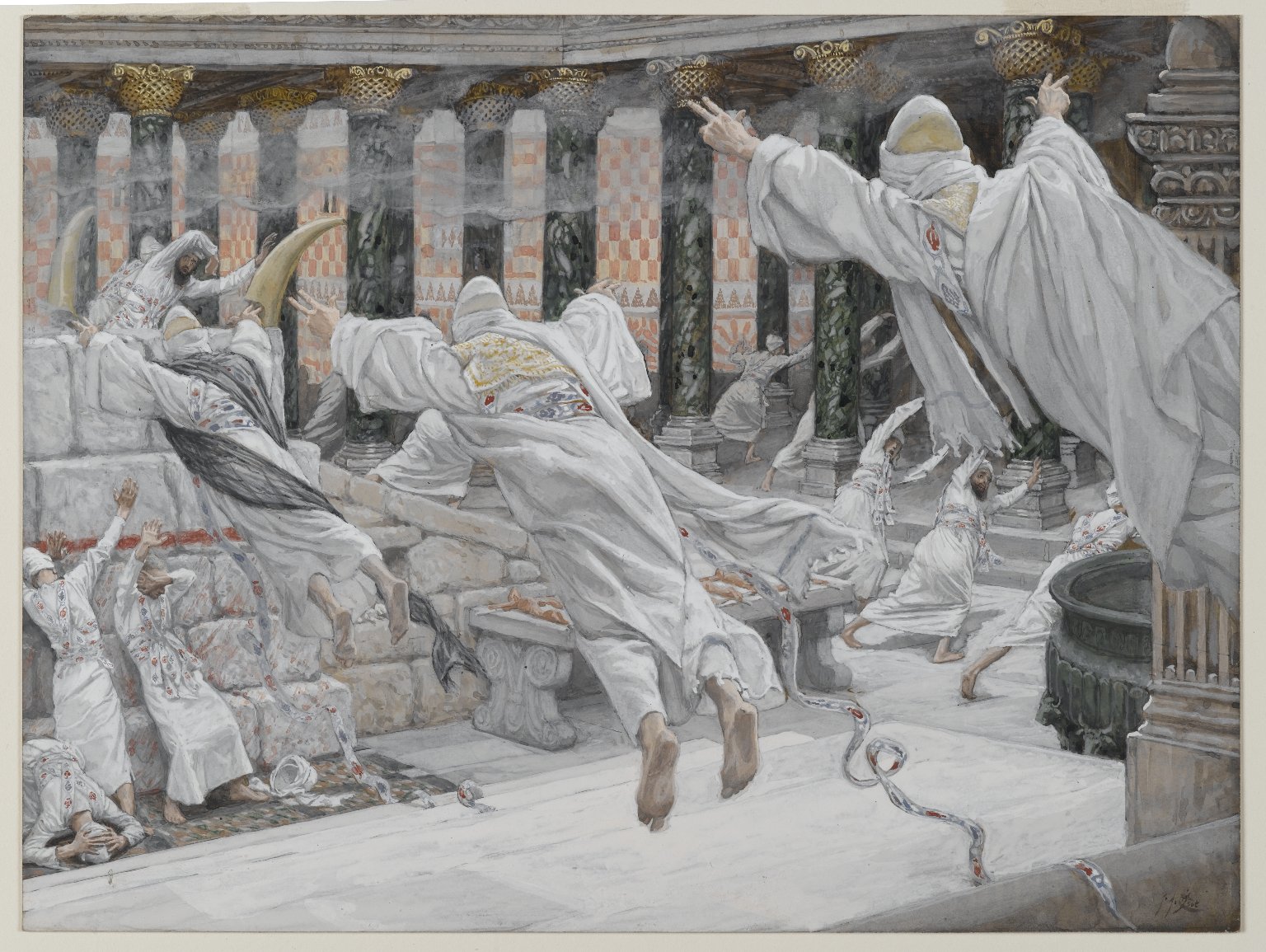
I had either forgotten or missed this bit in Matthew, verses 50-53: “And when Jesus had cried out again in a loud voice, he gave up his spirit. At that moment the curtain of the temple was torn in two from top to bottom. The earth shook, the rocks split and the tombs broke open. The bodies of many holy people who had died were raised to life. They came out of the tombs after Jesus’ resurrection and went into the holy city and appeared to many people.”

James Tissot (French, 1836-1902). The Dead Appear in the Temple (Les morts apparaissent dans le Temple).

This was reportedly witnessed by many people, including the Roman centurion guarding the crucifixion.Why isn’t more made of this, that resurrection from the dead was not a unique event upon Jesus’ death? I recognize that Jesus was himself a necromancer who, among other things, raised Lazarus from the dead (as well as two others, Jairus’ daughter and Nain’s widow’s son). But this story is far more remarkable. Many living dead men walked the city, meeting with the living not yet dead (although one might imagine some were frightened to death by the appearance of walking corpses).

This event occurred three days before Jesus himself arose from his tomb.

* * *

As an aside, how did Jesus select those three individuals he resurrected? Surely there were many who had died who were precious to the living. Presumably, Jesus had the power to raise them, as well.

And why not heal all the sick and crippled and drive out all demons forever? Shouldn’t Jesus stand head and shoulders above such charlatans as Benny Hinn who only heal selectively?

Liberalism and Inequality

To the extent that liberalism explains inequality by appealing to biological differences between individuals this ideology aligns with social Darwinism. (Liberalism also includes many virtues, such as free thought and expression and the demand for an open society, but in capitalist society it serves the purpose of rationalizing inequality by promoting the rightfulness of private ownership and minority control of the means of production.) However, the claim that biological differences explain inequality goes beyond rationalization of inequalities born of class relations. Given that the differences associated with inequality may be portrayed as grouped differences, the explanation also becomes a racist one. Put another way, if one explains inequality based on the constitutional differences between racially-grouped individuals, then the evidence will reify the fiction of race. 

Why? Blacks as a group trail whites in every significant category of life changes, which is to say that, as a group, whites achieve more than blacks in nearly every area of social and economic life—educationally, occupationally, and so on. The problem with social Darwinism is of course generalizing from individuals preordered by racist ideology. The social Darwinist doesn’t analyze the racist structures that produce group differences along racial lines. Nor does he discard the racist system of defining and ordering categories by race. Rather he uses these categories to disguise the source of the problem (and, tragically, so do progressives with their leftwing identitarian-style politics—more on that later). The social Darwinist appears to make an error in causal thinking. But the error is not a mistake. He means to misdirect his audience.

US rightwing libertarianism—to be distinguished from civil libertarianism (those of us who defend the Bill of Rights) and continental libertarianism (which is associated with anarchism)—is the more obvious expression of the racism inhering in the neoclassical liberal explanation of inequality. See, for example, F. A. Hayek’s The Constitution of Liberty. There Hayek makes the argument that inequality is the purpose of liberty and that the source of inequality is first and foremost the result of constitutional differences between individuals (while cleverly avoiding explicit racial categorization). But this extreme view doesn’t mean that the classist and racist attitudes are unrelated to the larger worldview supported by liberal ideology. Liberalism was social Darwinistic before the neoclassical innovation that underpins contemporary US libertarianism. Moreover, because an explanation rooting inequality in biological difference reinforces a naturalistic sense of hierarchical social ordering, social Darwinism promotes authoritarian political and legal structures designed to sustain these hierarchies, as well advances a victim-blaming ideology that functions to legitimate and rationalize human suffering. In other words, rightwing libertarianism uses the rhetoric of liberty to dissimulate the authoritarian structuring of social relations, and it derives this attitude from classical liberalism.

Social Darwinism relies on authoritarian political and legal structures because, if we view the world through the lens of science, inequality is in fact not caused natural differences among individuals, but by a class-based political-economic system that appropriates the value produced by human labor through exclusive control over the forces of production—command of land, resources, technology, and human capital. Grouped differences are not the result of a natural ordering of individuals by racial categories, but rather result from a ideological system that sorts human being into artificial categories for political and economic purposes.

Liberal ideology in bourgeois societies promote a mythology that obscures the real character of exploitative capitalist relations by elevating oppression to a virtue through the fetishism of individual liberty and thereby rationalizing its negative effects. Capitalism converts its failure to provide for everybody into the justification for its preservation. This is why most Americans, while not believing the United States should be as unequal as it is (albeit not knowing how unequal it really is), still believe it should be unequal on the grounds that inequality is the normal state of affairs in human societies. Centuries of bourgeois ideology have projected social Darwinistic logic into our cultural DNA, so to speak. This is also the reason why people will remind you that we do not live in a democracy. “It’s a republic!” they say. Yes, but it’s a democratic republic. At least it’s supposed to be. At least it should be!

Those who reject the ideology of social Darwinism, or are at least uncomfortable with it, often call themselves liberals, unaware that it is liberalism that is the ideology rationalizing these injustices. In my conversations with self-described liberals I discover that a lot of them are closeted socialists; they’re against inequalities based on class but are afraid to embrace the socialist label, a fear that results from a decades-long effective smear campaign against socialist politics and humanist desire. However, for many, the problem is not as simple as courage in changing labels. To the extent that their self-identification has led them to identify with organizations, parties, and causes that are liberal, their political and moral consciousness is fragmented and contradictory. They are falsely conscious of their class position and do not possess the attitudes that would align consciousness with their class position, an actual material position that comes with objectively grouped interests. Part of the reason why their consciousness is fractured is because they, too, believe the inequality lies along lines of race and not along lines of class. They don’t see that ending material inequality by abolishing exploitative economic relations at once ends inequality identifiable by the imposition of the fiction of race.

Update: I have created a podcast based on this text.

Failing Women Under Islam

On Monday, June 2, 2014, the Toronto Star published a letter to the editor by Judy Haiven, a professor in the Department of Management at Saint Mary’s University, Halifax, Nova Scotia. Professor Haiven was responding to a story covered by the newspaper about a woman who was stoned to death outside a court on Mary 28th in Pakistan.  It was reported as an “honor killing.” The story noted that, since 2013, as of the time of the story being penned, 869 women in Pakistan were victims of honor killing.

The letter, which is making the rounds on progressive social media, is a classic example of how, for some Westerners, eagerness to deflect criticism of Islam diminishes the capacity to objectively determine and assess the relevant facts concerning violence against women in Muslim-dominated countries, effectively downplaying the extent of suffering of women and girls under Islam.

Professor Haiven writes, 

Your article says that, since 2013, 869 women suffered “honor killings” in Pakistan. Compare this to the United States, where three women a day are killed by their male partners or husbands. By my count, since 2013 about 1,095 women were killed by men who think they have been dishonoured by their female partners.

Maybe the women wanted to leave the marriage, or had found a new partner, but clearly the men felt betrayed and dishonoured by their partners and killed them. The media are quick to target women murders in Muslim-dominated countries, but maybe the media should also look at the facts in the U.S. (and Canada) as well.

Of course, the media should look at the facts of violence against women in the US (and Canada). But the article in question was about violence against women in Pakistan, which is significantly worse in Pakistan than it is in North America.

Pakistan, with a population of approximately 180 million people, is roughly 56 percent of the size of the United States, which has a population of approximately 320 million people. It should have been obvious to Professor Haiven that, controlling for population size, honor killings in Pakistan are proportionately higher than in the United States even if we assume all violence against women in the latter country are analogous to honor killings. Assuming women are approximately half the population of each country, not controlling for age (which presents women with different levels of risks), the death rate for female victims of domestic violence is .68 per 100,000 in the US compared to a higher rate of .96 per 100,000 for Pakistan. The difference in rates is so significant that greater precision won’t change its significance.

Professor Haiven compares honor killings in Pakistan with all cases of female deaths from domestic violence in the United States. Honor killings are a subset of female deaths from domestic violence. It is estimated that 5,000 women are killed per year in Pakistan from domestic violence.  That’s a murder rate of 5.5 per 100,000 – a rate eight times higher than the United States. Add to this figure some 800 Pakistani women who kill themselves every year to escape an abusive relationship.

Violence against women is not generally regarded as criminal in Pakistan – even violence that ends in homicide. When attempts are made to address the epidemic of violence, such as the Punjab Protection of Women Against Violence Act of 2015, mainstream Islamic parties, clerics, and other Islamic entities aggressively voice their opposition, declaring such laws “un-Islamic” (as are laws attempting to stop child marriages, lessen the burden of absurd evidentiary standards in cases of rape, etc.).  Even where laws are passed, they are rarely enforced as they are not seen as legitimate because they contradict Islamic law. Moreover, most victims of violence are too afraid to report crimes, and those that do are often intimidated into withdrawing complaints. 

It is widely recognized among human rights observers that there is an epidemic of violence against women in Pakistan. Women by the several thousands are burned, strangled, dismembered, and driven to suicide every year in this Muslim-dominated country. Thousands more maimed in brutal beatings, disfigured with acid, and raped with little recourse (they need four male witnesses to testify to the rape before authorities will even consider trying the case, and then the victim’s life is in mortal danger). Children are married off to adult men.  And along side these horrors, women are routinely subject to less-than-debilitating beatings by their husbands and male relatives, leaving deep emotional scars. This violence is in significant measure rooted in the misogynistic character of real world Islam. 

To suggest that Western media is “quick to target women murders in Muslim-dominated countries,” not subtly implying that taking up the matter of the crisis of violence against women in Pakistan issues from anti-Muslim bias, and, furthermore, that placing the blame where it belongs (to a significant degree on Islamic belief), is an outrageous act of denying the suffering of Pakistani women and the ideology that cause that suffering.