Rex 48

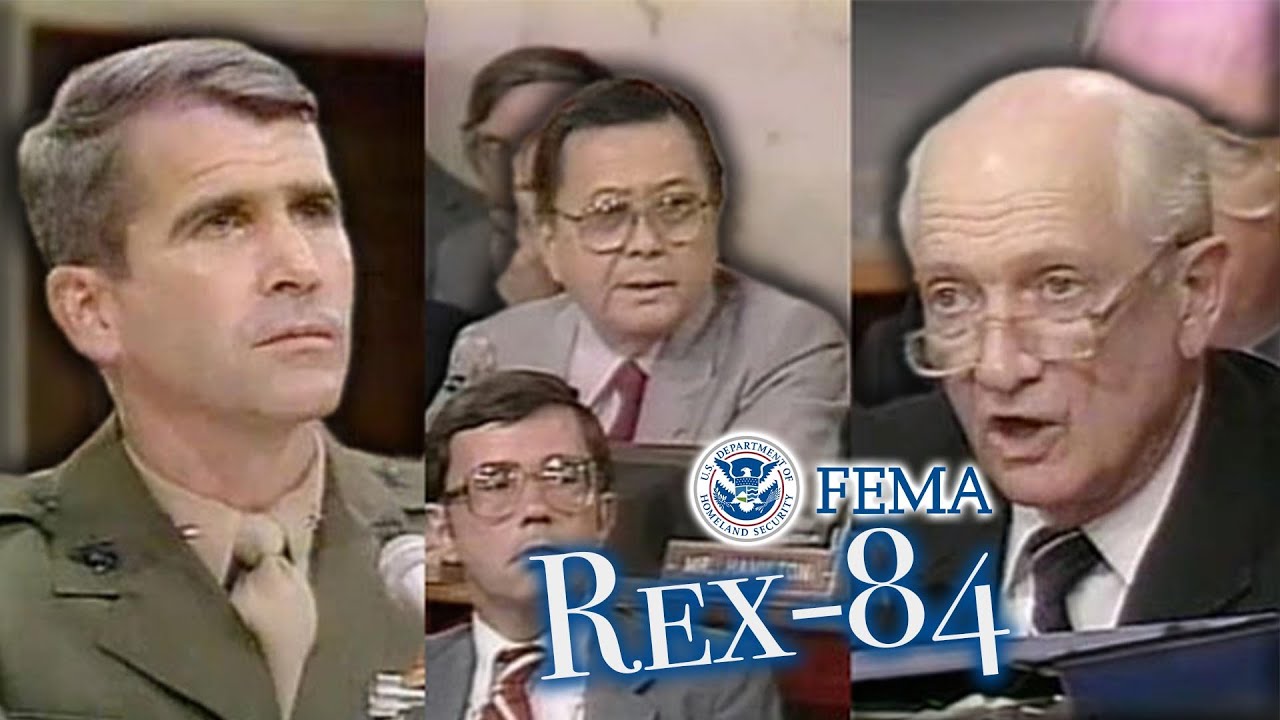
From the transcripts from the Iran-Contra Hearings in 1987. Dialog between Congressman Jack Brooks, Oliver North’s attorney, Brendan Sullivan, and Senator Daniel Inouye, the Democratic Chair of the joint Senate-House Committee:

Brooks: Colonel North, in your work at the NSC were you not assigned, at one time, to work on plans for the continuity of government in the event of a major disaster?

Sullivan [agitated]: Mr. Chairman?

Inouye [sternly]: I believe that question touches upon a highly sensitive and classified area so may I request that you not touch upon that?

Brooks: I was particularly concerned, Mr. Chairman, because I read in Miami papers, and several others, that there had been a plan developed, by that same agency, a contingency plan in the event of emergency, that would suspend the American constitution. And I was deeply concerned about it and wondered if that was an area in which he had worked. I believe that it was and I wanted to get his confirmation.

Inouye [more sternly]: May I most respectfully request that that matter not be touched upon at this stage. If we wish to get into this, I’m certain arrangements can be made for an executive session.

This dialog concerns Rex 84 (Readiness Exercise 1984), a detailed plan, developed by Oliver North, deputy director for political-military affairs of the NSC, Louis Giuffrida, head of FEMA, and vice president George H.W. Bush to declare martial law, suspend the United States Constitution, put military commanders in charge of state and local governments, and detain large numbers of citizens deemed threats to national security. All that would be required for this to be enacted is for the US president to declare a “State of Domestic National Emergency.” Listed among activities that could trigger such an emergency is widespread opposition to a US military invasion abroad.

North co-authored the report with John Brinkerhoff, deputy director of FEMA’s national preparedness program. The plan is based on a Army War College template published in 1970 by FEMA chief Louis Giuffrida. The original plan proposed detaining 21 million “American Negroes” in the event that there was a “black militant uprising.”

You can watch the exchange here:

Private Property is not a Monolithic Thing: The Problem of Public Accommodations

A business is a special class of private property, yet Ron Paul and other self-styled “libertarians” speak of private property as if it were one all-inclusive class of things operating under the same set of rules. In a contentious appearance on the Larry O’Donnell show, Paul claims that forcing a white-only restaurant to serve black customers, which is authorized under Title II of the 1964 Civil Rights Acts, hyperbolically characterized as the government “taking over private property,” is like “taking over the bedroom.”

Ron Paul

The analogy is absurd. I don’t need a business or any other license or permit to sell my car to the teenager down the block. I just need a title. I can sell that car to anybody I choose. If I want to sell my car to a white person I will. If I don’t want to let black people into my home, I don’t have to. However, if I run a business, I fall under a different set of rules because it’s a different type of property. It’s capital. I must obtain local, state, and, sometimes, even federal and professional licenses and permits. Additionally, I must obtain a state tax license, labor department registration, employer identification number, etc.

If my home is not a public accommodation, then I decide whether blacks can sleep in it. If my home becomes a public accommodation, then I don’t have that choice. This is because it has become a business.

Here’s the essential difference: A person or group of persons who want to go into business must seek the state’s blessing. The state grants a license—a privilege—to a business thereby legitimizing its operation and retaining the express power to regulate that business. (Businesses that decide to operate without the state privilege become part of the black market. Yet when I sell my car, I do not become part of the illegal market.)

When the term “right” is appealed to in the context of the business-state relation, the term is assumed to be a condition legally conferred, not an inherent or natural right. This is because only individuals have inherent rights—and the right to operate a business that harms persons’ civil liberties is not among them. To be sure, businesses have protections in the law, but none of these are allowed in principle to exclude and harm without reason (i.e. rational secular justification). I say in principle because this often doesn’t always work in practice due to the power of capital in influencing government action or inaction (see, for example, mountain top removal). However, just because the state doesn’t act consistently on principle doesn’t mean the principle isn’t well established.

The state has always had the authority to compel establishments serving the public to open their services to everybody. The Civil Rights Act of 1964 confirmed this by providing the machinery to force state governments to recognize the unalienable rights of US citizens—life, liberty, and the pursuit happiness, which are self-evidently compromised by the racist “separate but equal” doctrine—by banning laws permitting or requiring segregation.

Paul and his ilk make two errors. First, they fallaciously separate private and public sectors, as if a public accommodation can refuse to serve black people without that refusal enjoying or suffering either positive or negative sanction by the state. There is no neutral state position relative to business in the concrete—this is to say, any state that permits racial discrimination in public accommodations acts in a racially discriminatory fashion. It is basic to common legal understanding that laws that either require or permit establishments to discriminate against certain group members are themselves discriminatory and must be struck down in order to restore the inherent right. Therefore, discrimination in labor and consumer markets had to fall along with policies and acts of state discrimination; there is no disentangling the spheres; they rise or fall together.

Milton Friedman

Neoclassical liberal thought is shot through with this error of reification. See the works of Milton Friedman or Friedrich Hayek. So busy building ships in bottles were they that it’s comical to watch how confused they could become when trying to talk about the concrete character of actual political economic systems. Friedman looked particularly foolish on a regular basis, since he was keen on getting in front of audiences and challenging college students to match wits with him.

Libertarians (I am talking about true libertarians now), on the other hand, don’t commit the fallacy of misplaced concreteness because they consistently operate on the principle of personal sovereignty. That’s what makes it an intrinsically left-wing philosophy and practice: the aim to dismantle all illegitimate hierarchy. Not so with so called “libertarians” like Ron Paul. Paul desires to keep the capitalist hierarchy firmly in place and more: entrench the hierarchy even further by weakening the democratic machinery (the positive freedom side) of the republic.

Second (and this isn’t so much error as it is propaganda), neoclassical liberals want to flip the universe by making the alleged right of business unalienable while characterizing the rights of individuals as apparent privileges. In doing so, they explicitly put property before people; they are essentially arguing that having capital gives one person the right to oppress other persons, and if that person is white, then he is free to oppress black persons. In other words, they use the rhetoric of private property to justify apartheid. I do wish they would finally admit that the inevitable conclusion of their argument is that de jure race segregation is a legitimate outcome of capitalist property relations.

Finally, concerning Paul’s mantra of federalism and strict constructionism, given that the federal government is, according to the Constitution, the supreme law of the land (readers are familiar with the supremacy clause, no?), and the obvious fact that states do not have rights but powers (only individual persons have rights), Ron Paul supporters don’t have a leg to stand on. The bottom line: Paul’s rhetoric is subterfuge in defense of white nationalism. Maybe some Ron Paul supporters don’t recognize that. But it is what it is.

Junior Achievement. Relevant Bits of the Letter I Wrote the Principal

I have reviewed the materials and, as expected, the design of the Junior Achievement program is intended to obscure the true character of capitalist relations in quite profound ways and to the detriment of cognitive and moral development of our children. Corporate propaganda is designed by very clever ideologues to build in at an early age tacit acceptance of an ecologically unsustainable and immoral system of economic exploitation and social injustice. …

In “Sweet ‘O’ Donut,” the lesson on unit versus assembly-line production … there is zero discussion about the consequences of the Fordist and Taylorist model of industrial efficiency being taught to the kids. There are easy-to-grasp consequences of rationalizing production in this way in a capitalist economy, many of them detrimental to the interests of workers, which is the destiny of nearly every child in the public school system. Allow me to explain.

The motive behind the rationalization of production is raising the value of production, or what modern economics calls “value added,” generated during each worker hour, which, under capitalism, means a larger share of (unearned) income for the owners of the means of production, but not more wages for the workers, even though the workers add all of the value generated during their part of production. Put another way, the factory workers produce more commodities in a given unit of time in order to enrich the factory owners who do no productive work. This is the source of inequality in capitalist societies.

I will (briefly) work out this process mathematically to show you how it works. According to the 2006 Survey of Manufactures, conducted by the US Census Bureau, we see that industrial workers (i.e. workers in manufacturing) were compensated for their labor at an hourly rate of $18.33 (this amount is what we call variable capital).  We also see that the hourly rate of value added during production was $122.73. Part of this value added goes to pay for the $18.33 paid to the worker per hour. What happens to the rest of it, to the $104.40, what we call surplus value? It goes to the capitalist.

Let me make this point more dramatically, because this is the essence of capitalist exploitation. If we divide $104.40 (the surplus value) by $18.33 (the variable capital, or wages) we find that the worker produced 5.69 times the amount of value he received in wages in 2006. (Note: the raw materials, machines, etc, what we call constant capital, contribute no value to production, as they are consumed in the production process. These costs occur before the added value component. Here we are looking only at the variable capital input, since this is the sole source of profit in a capitalist market.)

The more productive the process can be made, the greater the surplus value for the capitalist. Let’s look at the 1996 numbers. Value added by manufacture per production worker’s hour was $65.14. Workers received before taxes an average of $12.40 per hour. Using the same formula as above, we find that the worker produced 4.25 times the value she received in wages.  We can see by this calculation that the rate of exploitation increased over the decade in question. Why? Because of increasing productivity with no benefit for the direct producers, precisely what “Sweet ‘O’ Donuts” aims to sell to students as a benefit with no negative consequences. The rising rate of exploitation was the source of the rising degree of inequality and concentration of wealth that contributed directly to the economic collapse in 2008.

Beyond economic calamity, the detrimental consequences are many. The worker’s income declines relative to the capitalist’s (more sharply if she is not a member of a collective bargaining unit). The worker is deskilled through task specialization. Her understanding of the production process is diminished. In the example, rather than each worker knowing how to make donuts, each worker only knows how to make one aspect of the Sweet “O” Donuts donuts. Thus their capacity to think and the extent of their knowledge of production is reduced. In the exercise [the student] was meant to learn the value of this by pitting skilled labor against robotized deskilled labor replete with inspection (“quality control”). This was not in his interests as a future worker or in becoming a complete moral person.

As noted, increasing the productivity of workers – which could, in a democratic economic model, be used to increase wages and benefits and shorten the work week – is the source of unemployment under capitalism, as fewer workers are needed for equivalent production output. Aided by machines, the number of workers can be reduced even more, to the point where many of the workers[/students] … could become unemployed.

I don’t see anywhere in the materials any criticism of assembly-line production. A curriculum could be derived for George Ritzer’s The McDonaldization of Society, in which the detrimental effects of Fordism and Taylorism on society are rigorously documented and analyzed in a clear and concise way. He shows that rationalizing production in these ways diminishes social interaction and alienates workers, deskills them, causes repetitive motion injury, heightens work related stress (as clock time comes to dominate the worker’s daily routine), raises the level of structural unemployment, and increases inequality.

In this and other exercises, the capitalist is never mentioned. For example, in the lesson on government, the children are “paid” five dollars for their productive efforts. The money is said to come from the sale of Sweet “O” Donuts products. Yet the owner of the company is never identified. Nor is profit – or more importantly the source of profit – ever mentioned. It is as if all the money generated by the sale of the commodities is distributed equally among the students. On the contrary, under capitalism the value added by labor is realized as profit in the market and banked by the capitalist, as I demonstrated above. The wages are advanced along with the costs of capital, i.e. materials, machines, etc., all of which were, crucially, produced by previous labor while capitalists profited at every stage.

A realistic and therefore more useful classroom exercise would have the Junior Achievement facilitator/volunteer posing as the capitalist sitting at a table with a large pile of the play money giving orders while the students posing as workers receive but a fraction of the income generated by their labor in exchange for making more donuts. It would be explained to them that they have to sell their labor (i.e. rent themselves) to the Junior Achievement facilitator because they do not themselves collectively own the means of production. It would be explained that the capitalist not only lives off their work, but lives in a much bigger house, eats more nutritious food, wears nicer clothes, receives better health care, and has more leisure time because of the work the students/workers are performing. A classroom could do a similar demonstration of slavery in order to drive home the point of the immorality of such systems.

Of course I recognize that, while it is permissible to condemn slavery in contemporary U.S. society, it is not permissible to make the same condemnation about capitalism. At the same, it wasn’t permissible to make that point about slavery back in the days when slavery prevailed. Indeed, back then, a lot of people didn’t see the problem of slavery at all.  They were taught in school that it was an appropriate way to make money.

The exercise I have been detailing could be combined with the assembly-line production lesson to show how capitalists drive other (smaller) capitalists out of business, displace workers through rationalization, and accumulate every larger piles of money, while the students continue working or work not at all, as many will have lost their jobs. Then some of the students assigned to be government workers, which are in the Junior Achievement materials (see “The Role of Government”) portrayed as police officers (whose real world function is to maintain the unjust status quo in property relations, a role that is never explored in the lesson) could pretend to be welfare case workers who will manage the poor and unemployed students – that is, the victims of the actual process of capitalism. I imagine that parents of students of Aldo Leopold would be represented by this exercise. Are not the poor and unemployed members of the community, disproportionately minority and female, important enough to be represented in these exercises? Shouldn’t the link be made between wealth and poverty? After all, we can’t all be wealthy in a capitalist society. In fact, most of us can’t be. The inherent logic of capitalist production precludes it. A simple classroom exercise illustrating this could be derived from Jeffery Reiman’s classic The Rich Get Richer and the Poor Get Prison.

Another example of the function of the curriculum to obscure reality is found in the lesson on money, “Money Moves.” The children are instructed to sit in a circle and pass a quarter to each other, each spending it to buy something they need to keep business or other activity going. This is supposed to demonstrate the circulation of money. But this is not what happens in a capitalist economy. Under capitalism, money is invested and commodities are sold for more money than the initial investment. What is being described in the exercise is simple commodity circulation (and even here is a mystifying oversimplification), something that happens in pre-capitalist societies where money is merely a symbolic unit of exchange. In fact, make the transfer of stuff in the example direct without money and you have a barter system. Capitalism is impossible under the model the students are demonstrating here. It manufactures the illusion that nobody is benefiting at anybody else’s expense. It avoids having to explain the source of profit.

Now, if the objection be made that what I have written is over the heads of students, I would counter that it is easy enough to create simple models simulating the real world experience of capitalism (I suggested two). In fact, simply setting up a simulation where the Junior Achievement facilitator ends up with a big pile of money at the end of exercise, while students get far less money and are dispossessed and displaced by efficiency regimes, and then asking students if they think that is fair should suffice to make the point. If not, drawing an analogy to slavery would. Despite how odd it sounds to hear such an analogy, it is true that, while capitalism is a different mode of exploitation, capitalism is still an exploitative system, and in fact operates on the same profit-making principle as did chattel slavery in the antebellum southern United States.

To be sure, teaching an alternative curriculum would be a subversive and democratic act that would likely bring an outcry from the business community who would besiege the school board with complaints, organize astroturf letter writing campaigns to smear the teachers, and marshal the power of the corporate media to make public education look anti-business. This despite the fact that it would be to the benefit of nearly every family associated with Aldo Leopold. Then why is it to be accepted as normal and unproblematic for Junior Achievement’s “Our Community” to be taught in schools? Herein resides the tacit and undeserved legitimacy of the corporate capitalist worldview over against the interests of the majority, namely the working class. As one of the most influential of all social scientists once observed, “The ruling ideas of any age are the ideas of the ruling class.”

Which brings me to my final point: if you feel you can’t allow teachers and students to speak truth to power at [the school in question], then why allow any economic agenda into the classroom? If the other side is too complicated, too troubling, then why permit propagandists to confuse children about the world they live in? When you think about it, given its detachment from the operation of the real world, “Our Community” possesses a religious quality. Junior Achievement is dogma, not enlightenment. It takes capitalism and elevates it to a virtue and then systematically masks the history and reality of the system in order to brainwash children into accepting a system that exploits them and destroys the environment. As such, it is out of place in a public educational setting and, really, not befitting a democratic society.

The Truth the Left Must Grasp About Obama

Obama isn’t giving ground. He isn’t caving. He isn’t timid, confused, or unsure of himself. He simply isn’t one of us. If he wins re-election, he will become even more of what he is right now and has been for years: a neoliberal globalist. His campaign was a sham. (The great untold story of our age is how millions of left and left of center voters allowed themselves to be so completely bamboozled by an obvious Madison Avenue-style campaign.) Obama’s election sucked much of the energy out of anti-corporate/anti-war movement. The election of Obama to office was a spectacular propaganda achievement by the corporations that own the country.

President Barack Obama

What the left must now understand (what they should have understood all along) is that Obama is a key player in a structural adjustment program being imposed on the United States by finance capital. Obama had to be the bringer of the austerity phase of the project because the ruling class knew progressives wouldn’t go for it if McCain were president. If it were McCain cutting Medicare, expanding military presence in Central Asia, Middle East, and Africa (imperialism), extending the PATRIOT Act, as well as George Bush’s tax cuts, organizing assassination squads, undermining Social Security, etc., progressives would be howling. But because it’s Obama, they instead rationalize, apologize, make excuses, and blame Republicans.

Such rationalization as, “We’re stuck with him,” would sound ridiculous to progressives if it were McCain doing all the things Obama is doing. We would instead hear: “We have to get this man out of office.” But it’s just as ridiculous to say shrug off the situation with Obama. In fact, that he commands the obedience of so many citizens makes him worse than McCain. The Obama years will be looked back upon as among the worst in the rollback of democracy gained during the 20th century. The United States is now being fully re-articulated into the global capitalist economy, but this time with a different locus of power: a transnational ruling elite. Both parties are servants of the project. It’s time to withdraw consent from the two-party system. They win. We lose.

The Appeal to Human Nature

There is an argument that hierarchy and inequality are a reflection of human nature, not the result of unjust social arrangements. 

If we are to address this question of a human nature objectively, then we will have to agree that determining our nature requires looking at the history and prehistory of the species scientifically and historically. As a distinct species, Homo sapiens has been around, in its modern form, for at least 200,000 years. The species originated in Africa and migrated outward, reaching nearly every part of the world by roughly 25-35 thousand years before present. Some 6-10 thousand years ago some groups of Homo sapiens began living in large-scale social systems in the Indus, Nile, Tigris-Euphrates, and Yangtze River valleys. Meanwhile, most members of the species continued to live outside the city-state environment for thousands of more years, finally being incorporated (with a few notable exceptions) into modern world-system by the mid-twentieth century.

It is with the emergence of the city-states that we see the regular appearance of the major forms of social segmentation, i.e. class, gender, and ethnic divisions, unjust arrangements which, over time, required, among other things, an ideology claiming that selfishness is part of human nature, which in turn, it was said, explained such things as exploitation, genocide, property, war, and so on (as if these are simply the natural conditions of human existence). However, before the city-state and outside it, human beings for the most part lived in democratic egalitarian social orders, communities based on cooperation, sharing, and compassion. In essence, these societies were based on altruistic relations and behaviors, not on selfish ones.

Let’s do the math: Taking the more generous number of 10,000 years ago to establish the emergence of the selfish conception of human nature, and the conservative number of 200,000 years for the existence of the species (it’s probably longer, and moreover we have earlier hominids displaying symbolic culture who also enjoyed communal existence going back more than a million years), we find, measured temporally, that 95 percent of human beings lived in communist and socialist societies in which either everybody owned everything in common or those who worked kept what they earned for their families (which were extended and essentially covered, through larger familial networks, the entire community). In other words, at best, only 5 percent of human beings have lived in the types of social orders that the advocates of selfishness (and exploitation and inequality) seek to legitimize with their appeal to human nature.

Judging the matter using archeological, anthropological, historical, and sociological facts and analyses, we would have to conclude, from a human nature standpoint, that class-based societies are contrary to human nature, not a reflection of it.