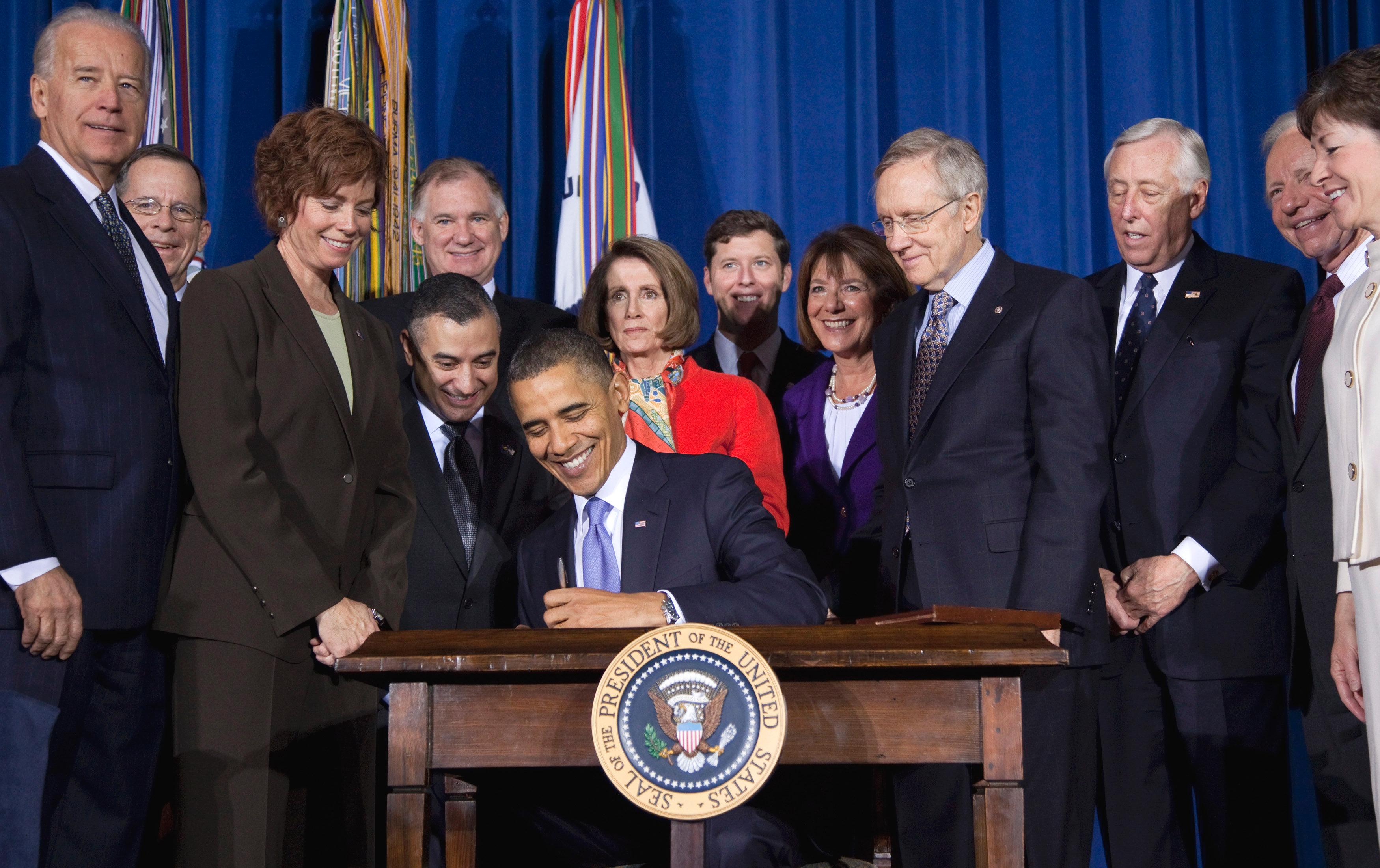
The repeal of “Don’t ask, don’t tell,” or DADT, is being hailed as a signature accomplishment by Barack Obama, something akin to Truman desegregating the military. It certainly is a great moment for the gay and lesbian community and those who support them. Any time a form of discrimination is knocked down, those who are discriminated against and those of us who believe in equality win. I have been pushing the repeal of DADT since it was put into effect under Clinton. I’m elated to see it fall (albeit I am concerned about its contingent wording in the bill Obama will sign).
But let’s be honest. The homosexual community and those who support gay and lesbian rights are responsible for this victory. We must not give all or most of the credit to elites when it is the people who did the heavy lifting. The black community and its supporters appreciated Lyndon Johnson’s support of the Civil Rights Act of 1964. It was a brave thing to do and ultimately destructive to the Democratic Party. But it was the civil right movement, led by such moral leaders as Martin Luther King, Jr., who deserve the credit. The gay and lesbian community and its supporters have been dedicated to overthrowing this discriminatory policy, and this victory is for the most part theirs.
Moreover, we should never give too much credit to authorities who stop perpetuating an immoral practice. Overturning segregation and, now heterosexism (though not entirely), are morally necessary acts, not favors. It’s about realizing a right, not enjoying a privilege. To be sure, Lincoln freed most slaves; but we should not treat the Emancipation Proclamation as a gift. A representative of the ruling class finally did the right thing (and this was only because he was forced to by circumstance). Therefore, we should ask ourselves exactly why Obama is signing this bill. Is there an ulterior motive underpinning Obama’s support for DADT? He is, after all, opposed to gay marriage.
Let’s be honest with ourselves. Obama would not support the repeal if the military were not encouraging him to do so. The country is now spending half of every tax dollar on the war machine. The military needs good soldiers. But the military’s discriminatory policy has made it difficult to recruit on college campuses, many of which bar groups that discriminate from using their facilities or occupying their grounds. Ending DADT makes the main justification for barring recruiters vanish. The military wants young bodies. Recruiters have to go where potential recruits are. Recruiters already work the economically disadvantaged neighborhoods. Opening up colleges and universities greatly expands the hunting grounds.
Furthermore, repealing DADT is politically useful to Obama. It gives Obama cover for the work he does for the power elite—the corporate bailouts, the wars, the surveillance and torture regimes, and a myriad of other things beneficial to the rich and detrimental to the working class and the poor. When Obama’s loyalty to progressive democratic politics is questioned (and his disloyalty to those further left confirmed), the administration and corporate media will simply trot out the repeal of DADT and say, “Well, if he is such a right winger, then why did he end DADT?”
There is little cost to Obama with DADT’s repeal. Conservatives aren’t going to vote for him anyway, and independents are ambivalent about gays in the military. The single-issue progressive Democrat is positively ecstatic over this action. In a fine display of magical thinking; it confirms his faith in his leader. In the final analysis, this repeal changes nothing about the essential truth of Obama. The president is still delivering the goods for the rich and powerful.
Don’t be naive. He didn’t do this for gays and lesbians or because he opposes inequality and discrimination. As Obama demonstrated during the campaign with Jeremiah Wright and Trinity United, he is prepared to throw under the bus any constituency in the progressive community that gets in the way of meeting the demands of the ruling class. Obama has demonstrated time and time again as president that his behavior during the campaign is standard operating procedure. Where’s card check? Where’s the public option? Where’s the repeal of the Bush tax cuts for the wealthy? Why aren’t our troops home from Iraq? Why is the Guantánamo Bay detention center still open?
Just got back from seeing Avatar. Great movie. It was a bit deliberate in the beginning as the director sought to have characters explain elements of the premise to the moviegoer, information that every character in the movie already knew and therefore didn’t need to hear again, but I guess the reasoning was that enough people would be too slow on the uptake – you know, with the general ignorance of colonialism and all – that it would be better just to clarify matters at the outset. Hand holding aside, it was a gorgeous and emotionally potent movie (I hope Roger Dean gets some credit for the visual elements he inspired).
One of the criticisms I am reading is that the movie is racist. The argument is that a great white warrior arriving to save the primitives from the colonizers, who happen to be his race of people, is a white supremacist trope. But this interpretation ignores one key fact: the main character becomes the “other” by transferring his consciousness into his avatar. And long before that he identifies with the other – and with nature. He is, as the antagonist puts it at the end, a race traitor. He rejects the colonizer identity and embraces the identity of the colonized. This is analogous to a white man rejecting his whiteness and identifying with oppressed peoples of color. This is ant-racist, not racist.
The whole point of the movie is that, when a man comes to know a people, lives with them, cries with them, bleeds with them, he no longer sees them as big blue monkeys but rather as living sentient moral beings like himself. He is able to judge right and wrong not from the colonizer’s point of view but from a universal point of view, wherein it is always wrong to destroy a people and plunder their resources and it is always right to side with the colonized against the colonizer. The corporation after the treasure of the indigenous beings is soulless. It only sees profit. And this is always the way of the colonizer. To find morality, one must stand against that, and in so doing, one becomes the other, since the other is the organic enemy of colonization and exploitation.
The movie is anti-racist, anti-colonialist, and anti-capitalist. If the message wasn’t clear enough in its premise, the dialogue certainly made it brutally obvious. By having the audience side with those whom the colonizers label “terrorists,” just as the transnational capitalist class operating through the United States and other western powers define those resisting occupation, the director is saying that it is okay for third worlders to go to war against the global corporation and its military. I am pleased this movie was made and that so many people are watching it. Let’s hope they get the point.
The world just got wackier. The NAACP was way out of line. And Obama proved in the most blatant way that he’s the white man’s black president. At least the NAACP has retracted its criticism and apologized to Shirley Sherrod. They admitted they were snookered by Andrew Breitbart, a conservative blogger and confirmed serial liar. He edited the tape to make it appear as if the U.S. Department of Agriculture official was discriminating against white farmers. Nothing could be further from the truth. In fact, it’s because of Sherrod’s efforts that the white farmer kept his land. And that was twenty-four years ago, years before she worked for the Department of Agriculture.
It would be nice if the NAACP would release the full tape they admit vindicates her (as if she needs vindicating from the tactics of a right-wing provocateur). Indeed, the white family whose farm she saved is shocked by the way she is being treated. Her story is one of understanding – that white people are just as screwed by capitalism as black people are.
Suppose we believe what we are being told to believe, that this is racism. But racism is a social system in which one racial group benefits systematically at the expense of another. It has never been true in the United States than blacks have benefited systematically at the expense of whites. It follows that her comments cannot be racist. To call this racism is to falsely reduce racism to race prejudice. Racism doesn’t even require race prejudice, and, these days, racists prefer its absence. This is a decades old project to change the meaning of racism to legitimate the false concepts of “reverse racism” and “reverse discrimination.”
That Obama caves every time the right wants him to participate in the white power project to dissimulate racism tells us the reason his election to office was desired by the powers that be.
The end goal of this political project is to make any form of racial consciousness equivalent to racism, no matter whose consciousness it is. It is, in essence, a project to cloak group power in egalitarian rhetoric in the absence of actual egalitarian arrangements. It is a manifestation of racist ideology.
This is the source of these terms “colorblind” and “postracial.” Colorblindness turns the struggle against racism into racism itself; if you accept the propaganda that racism reduces to race prejudice or individual acts of discrimination then you can falsely portray any individual as capable of being a racist.
Colonizers design ideological systems to rationalize oppression. Different rhetoric works at different times. Instilling in everybody’s mind the idea of black inferiority is one strategy. This has two dominant phases: The first is religious, where black skin is depicted as a curse from God. The second is scientific, in which blacks are said to be less evolved than whites. When people rise up and convince enough of their brothers and sisters that the prevailing ideology is a myth, then the oppressor is forced to develop a new strategy. But the myth is always structured in a way that rationalizes the power of the colonizer over the colonized. This is no less true of colorblindness. Beneath all these phases is the material fact of structured racial inequality.
Critical race theorists call these phases reflections of the “perpetrator’s perspective.” Because the oppressor commands social structure and shapes dominant ideology, the perpetrator’s perspective prevails in our institutions, law, education, etc. This is why, in law these days, one has to prove intent – and a very narrow conception of intent as the knowing purpose of an individual – in order to prove discrimination. Law school in most places is a system of indoctrination in which the perpetrator’s perspective is taught as the only legitimate perspective.
There is another perspective: the victim’s perspective. Those who are on the disadvantaged end of society’s hierarchy cannot usually point to a specific individual who has purposely put them in the ghetto or in a job serving white folks. The facts that they are disproportionately poor, sick, undereducated, unemployed, arrested, and imprisoned relative to whites are rationalized by the perpetrator’s perspective as not the fault of all those who are affluent, healthy, educated, employed, and free from harassment and jail and therefore the fault of the victim. We are all just individuals, after all, and there is no such thing as group power – so the mythology goes. Even some members of the oppressed group (Obama rarely misses a chance to) blame the victim for the crimes of the white establishment.
Equalitarian rhetoric masks inegalitarian arrangements. This is because racism is fundamentally a problem of the unequal distribution of power – and power has a direction. MLK argued that the problems of racism and colonialism will never be conquered without “a radical redistribution of political and economic power.”
HuffPost carried a story yesterday, “Orrin Hatch: Drug Test The Unemployed,” that, while troubling in the degree of authoritarian expressed by the senator’s statement, is more troubling in the proportion of the population who supports such a measure—if my students are any indication of popular sentiment. A lot of them think this is a good idea.
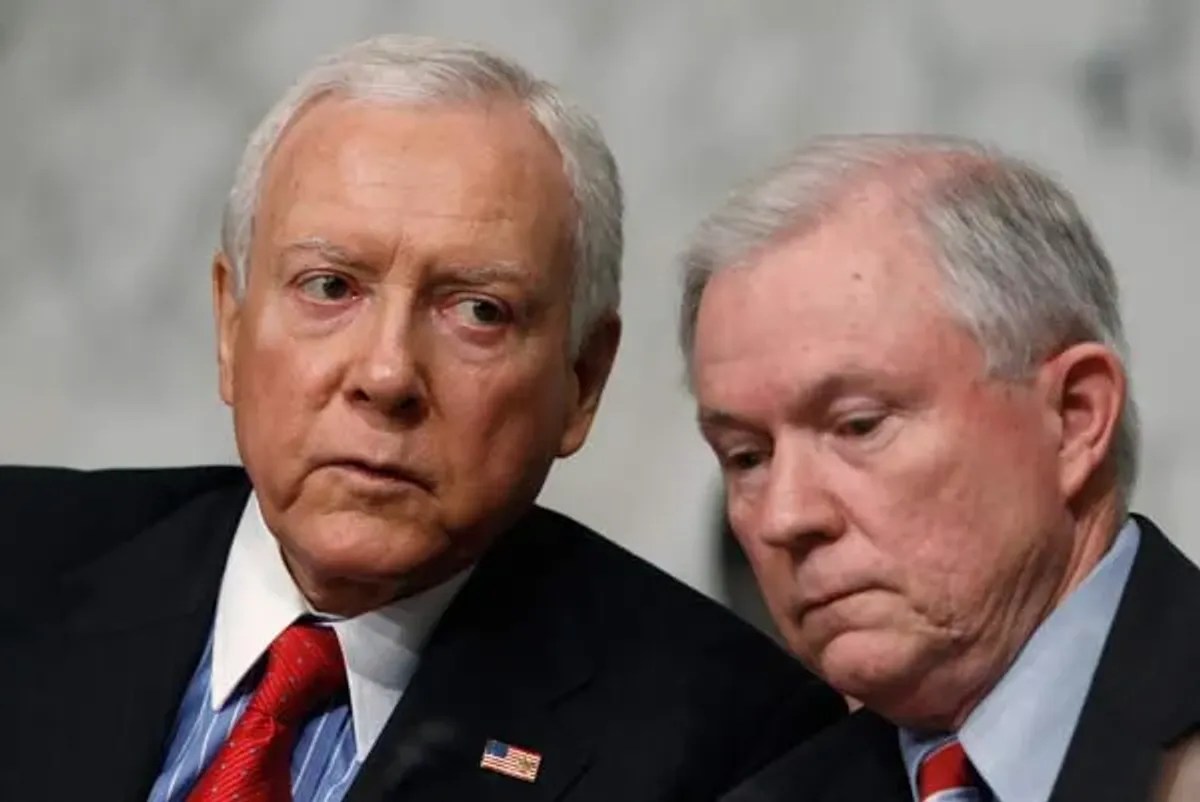
Utah Senator Orrin Hatch with Alabama Senator Jeff Sessions
It’s not a good idea to drug test anybody. It’s totalitarian. We don’t need bodily surveillance by the state or corporations anymore than we need the state to bug our phones or read our e-mail. It’s not that drug testing the unemployed is unnecessary; it’s that it is discriminatory.
For one thing, it’s classist. The unemployed are no different from anybody else except they don’t have a job. That’s not always or even for the most part their fault. Capitalism causes mass unemployment. Why degrade our brothers and sisters who are victimized by a system designed to benefit the few by making them piss in a cup? Isn’t it bad enough that they have to rent themselves when they’re lucky enough to be rented?
For another thing, by virtue of the fact that a disproportionate number of the unemployed are minorities, it’s racist. “But everybody is being tested!” Yes, but since minorities are disproportionately thrown into the industrial reserve during economic downturns by virtue of history and status, they will be disproportionately impacted by the policy
In a comment concerning this story in a Facebook post, I sarcastically said about the legislation, “Let’s bug their phones and read their email, too. All these unemployed people are probably talking and laughing behind our backs about how they’re bilking the taxpayer out of their money (let’s pretend for the moment that those drawing unemployment aren’t taxpayers themselves). If we’re going to invade a person’s privacy by sampling their urine and blood, then sampling their phone calls and correspondence is no problem at all, right?”
I went on to say, “Let’s all internalize the ethic of the police state and surveil each other and chant together: ‘Death to privacy! Death to privacy!’ We ought to do what they do in China and hire busybodies on every city block to spy on their neighbors and report to the government on their drug and sexual habits or whatever else the moral entrepreneurs desire to control these days. Why presume anybody’s innocent? Why preserve the Bill of Rights? We don’t need it any more. We have the PATRIOT Act. That’s right, the piss test is the new loyalty oath. It’s the new gold standard. Raise your right hand and swear you’re not a communist—er, I mean drug addict, and don’t forget to piss in this cup because we don’t believe you. It’s gold in more than just color and hue.
Here’s a stock tip for you: if this law passes, invest in drug testing corporations. The governments of the United States may be delivering to these surveillance firms millions of your fellow citizens as customers. Even if it doesn’t take off, you can look at to this way: you get some of tax dollars back. You may need them when you’re thrown out of work.
They’re already piss testing the good folks thrown out of work down in the Gulf states, thrown out of work courtesy of BP’s brilliant feats of technological genius. It’s not bad enough that fishers, net makers, and all the other workers in Gulf have to suffer the indignity of seeing their life way utterly devastated by greedy and reckless energy corporations. No, we have to go the extra mile and make them piss in a cup in front of a witness armed with latex gloves before we let them go out in the marshes and get exposed to all those toxins in order to clean up the mess BP made.
This idea is wrong and dangerous for so many reasons.
First, it’s a clear violation of the right to privacy and the presumption of innocence for the government to drug test citizens, particularly in this context.
The Fourth Amendment is quite clear on this matter: “ The right of the people to be secure in their persons, houses, papers, and effects, against unreasonable searches and seizures, shall not be violated, and no Warrants shall issue, but upon probable cause, supported by Oath or affirmation, and particularly describing the place to be searched, and the persons or things to be seized.” Beyond the problem of authoritarian desire, government drug testing of individuals without probable cause is unreasonable and therefore unconstitutional; I have the right to be secure in my person, and the government is required to protect that right.
The law runs afoul of the Fifth Amendment, as well, which states that no citizen shall be compelled to be a witness against themselves. This is the presumption of innocence which, like the right to privacy, is central to our freedom.
These rights are in principle true also with respect to private business firms, or at least ought to be; here, the government has utterly failed in its obligation to protect the rights of citizens. We don’t lose our civil rights when we go to work—at least we shouldn’t. Yet, the citizen doesn’t enjoy the same freedom of speech or association when she is at work.
This is problem with liberalism: it accepts the priority of capital over labor, representing a grave injustice to humanity. Because most people are forced by structural conditions to rent themselves to capital, and because the capitalist is allowed to use the workers’ labor towards his ends during the time he employs them, workers are less of a citizen during the time the capitalist uses them.
See, the rub is that, as with the slave, a worker’s labor comes with her (and the choice between working or not working, i.e., being used or being starved, is not validly rendered as the “freedom to choice”). This is why it is imperative to always keep in mind the struggle to abolish the system of wage labor so that all individuals can work for themselves and their families and their communities rather than for private interests (that is, the aristocracy).
Second, the attitude that underpins the pro-testing argument is authoritarian. In the mid-to-late nineteenth and early twentieth centuries, working people had to endure the social Darwinistic eugenicist claptrap of “scientific charity,” where the workers were divided into two categories: the “deserving poor,” e.g., the widow of a factory manager killed in war, and the “undeserving poor,” e.g., industrial workers disemployed by machinery either by accident or productivity gains. This was the method for selecting the majority for elimination from the public assistance rolls (and even elimination from society altogether through preventative incapacitation and sterilization).
The state’s claim was that this strategy would lessen the burden on the taxpayer by weeding out fraud and abuse, which, for the record, constitutes only a fraction of the paltry sum spent on public assistance and social insurance, especially compared to subsidies to business and spending on the military.
But the state’s claim is a lie. The reality is that scientific charity was shrewdly pushed by the industrialists and progressives as a method of labor control. It functioned in this capacity in several ways. For example, it kept the working class squabbling amongst itself, pitting one group of worker against another, often majority against minority and native against immigrant. This function was especially pronounced during periods of capitalist crisis when it was imperative to stifle class consciousness and labor solidarity and keep workers disorganized (like today).
This was also true for another of its functions, namely depressing wages. By throwing large numbers of people into destitution, the capitalist and his functionary forced workers still toiling in the factories to accept lower wages, lest they, too, be thrown into destitution. Yet another function was reinforcing the bourgeois ideology that people succeed or fail on account of their efforts and talents, obfuscating the reality that capitalism cannot employ all workers all the time, and sometimes it employs far fewer than at other times.
Still, even then, back then, the working people who were lucky enough to escape poverty weren’t eagerly prepared to sacrifice their civil liberties—privacy rights, the presumption of innocence, the right to remain silent—just to punish the so-called undeserving poor.
This is in stark contrast to today, where, with the death of the labor movement and the overgrowth of conservative religious ideology, much of the public is prepared to spite itself to derive some satisfaction from screwing over the poor. When a person says “we’re talking about druggies not those in need of assistance,” as a person said to me in defending this dreadful legislation, that man is not speaking truthfully (even if the falsehood comes honestly), since he is precisely talking about those in need of assistance.
Dazed by reactionary hatred for the least fortunate, it is often the case that folks making this argument don’t realize that if the government drug tests unemployed persons, then they will themselves be drug tested when they’re thrown out of work and seek assistance, an increasing possibility with the mounting capitalist crisis. At the same time, I often hear this when I ask them why a working person should want to be drug tested: “If you got nothing to hide you got nothing to worry about.” Every commissar in every totalitarian state rejoices hearing such slogans uttered by the people he seeks to control.
But this is not the way it works in free societies. In free societies, the state must have probable cause to harass citizens (you know, those people whose rights the state is supposed to be protecting). And the state’s burden must be great. There must be substantive probable cause, not “I think I smell pot” or “Why are your eyes so red?” We simply cannot allow the state to go on fishing expeditions, randomly drug testing people who are in a tight spot to see what turns up.
Advocates of piss testing represent an internalization of the authoritarian mentality. I know people bristle when I say this, but it must be said if we are to vigorously defend freedom. It’s tragic to see citizens manipulated into believing the greatest threat to their life chances come from beneath them, from the least powerful people, instead of above them, from the powerful people who really control their destinies (exploiting their labor, waging imperialist war, and wrecking the environment).
This false consciousness is evidenced by inverted priorities. Instead of getting exercised over the fact that the United States military budget exceeds a trillion dollars every year in pursuit of securing global capitalism, the taxpayer gets all worked up over a small portion of revenues going to unemployed workers—workers who pay taxes.
What every worker who loves her freedom ought to tell Orrin Hatch: “I’ll be damned if you’re going to piss test me. I pay taxes so that the state will be there for me when I need help. Now I need help, so don’t make my jump through a bunch of hoops that are popular among reactionary types who don’t have my interests in mind. I’m not a criminal. I’m a citizen and a human being.”
This brings me to the third point, namely this business about the perils of drug use. This exposes a bit of fallacious reasoning and, for many of those who oppose drugs, hypocrisy. We have a saying in science that, while you are entitled to your opinion, such as it is, you are not entitled to your facts. Here come some facts: The worst drugs in our society are cigarettes and alcohol and prescription drugs. Around half a million Americans die every year from tobacco consumption (some five million around the world die from smoking this weed). Some 85,000 Americans die every year from alcohol use. Deaths from cocaine are a fraction of the deaths attributable to alcohol. In fact, deaths from all illicit drug use combined runs around 15,000 persons annually, and many of these deaths are caused because these drugs are illegal (making them illegal makes them more unsafe). Nobody has ever died from smoking marijuana.
Do we kick people off of unemployment insurance because they smoke tobacco or drink alcohol? Of course not. You can answer that question by asking this question: “Do we live in a totalitarian society?” Moreover, almost as many Americans die from poor diet and physical inactivity every year as die from tobacco. Are we going to kick these folks off of unemployment insurance? Are we going to force them to stand on scales or run a bit on the treadmill to see if they’re short of breath?
If those advocating drug testing were consistent, then they would call for throwing people off the rolls for smoking and drinking and eating, too. That would likely eliminate most people from government assistance. Ah, even better, right? I hope not. Drug prohibition, like alcohol prohibition before it, has been a colossal failure—if judged from the perspective of human freedom. You can generalize that result.
As a matter of principle we have to get beyond this desire to micromanage the lives of other people. If people want to smoke pot or sniff cocaine or drink a martini or eat sausage and gravy, then it’s nobody’s business if they do. Nobody should be punished for making such a choice (often such choices carry their own punishments).
Beyond respecting personal choice and privacy, the drug war is a much greater threat to humanity than drug use. This isn’t a matter of opinion. We have tens of thousands of our brothers and sisters languishing in the gulags for drug possession. We have husbands, wives, fathers, mother, sons, and daughters snatched from their families and communities by the police state. Police cruise the inner cities like sharks in search of prey, kicking in doors on rumors and profiles and forcing human beings to the ground to be restrained by shackles and tortured with Tasers.
Of course, judged from the anti-freedom perspective, the drug war has been a tremendous success. It allows for the warehousing and premature deaths of hundreds of thousands of surplus people—millions over the course of years. It allows for the erosion of the civil liberties of all citizens, thus strengthening the hand of the state over the people. But what this represents for us, the people, especially when we internalize it and express our desire for it, is nothing short of catastrophic.
I am not shocked that so many of my fellow citizens agree with Orrin Hatch. Decades of indoctrination in authoritarian thinking has brought the population to this point. I know the power of ideology on the human psyche. I know that efficacy of mind control on the citizen. I know how irrational fear and hatred—of drugs and the people who use them—upend the moral capacities of otherwise decent people.
I am not shocked by it, but I am horrified by it. My horror has noting to do with a bleeding heart. It has to do with love of freedom.
In his April 16 entry at the Thomas Jefferson Street blog (US News and World Report) condemning the March 2 decision by Barbara Crabb of the US District Court for the Western District of Wisconsin, a decision in which the court declared the National Day of Prayer unconstitutional, Fox News and UPI political analyst Peter Roff repeats a mythology about American history, that the United States was founded as a religious nation. Whatever it might have become, the country was not founded as such.
Former student Bonnie Gutsch, now of the Freedom of Religion Foundation, showing her appreciation for Judge Crabb’s defense of our secular republic (Associated Press picture published by Madison.com)
“The men and women who first settled the North American continent were religious pilgrims looking for a promised land,” Roff contends. “Upon their arrival they established compacts and agreements that recognized the power and author of a Creator whom they worshiped and to whom they gave thanks for their safe arrival and survival.”
Roff claims that “the fact that they believed there was a linkage between faith and freedom is inescapable. The Declaration of Independence, for example, makes reference to the importance ‘the protection of Divine Providence’ played in the struggle for liberty against the tyrannical British King.” He continues: “The men who founded this country—those who wrote the documents that set forth our independence and those who established the framework for the national government—were not anti-religion nor were they irreligious. Even Thomas Jefferson, frequently depicted by historians as an unspiritual man, once wrote, ‘I have sworn upon the altar of God eternal hostility against every form of tyranny over the mind of man,’ a phrase inscribed on the frieze that circles the interior of his memorial in Washington, DC.”
Roff claims that the First Amendment contains two components: first, “the right to practice one’s religion without undue interference under the free exercise clause,” and, second, “the right to be free from disfavor or disparagement on account of religion under the establishment clause.”
Roff’s history lesson is typical of the Americanist outlook and his constitutional analysis is just as self-serving. Whatever the character of some of the colonies, the historical fact is that colonization of North America was carried out by the English state using chartered corporations composed of wealthy capitalists and wielding armies of white settlers. The motive was material gain, which required the expansion of the British Empire, albeit sublimated as English nationalist aspiration.
The British crown vested the corporations it chartered with political-juridical authority, and often, as social control agents often do, religion was used to manipulate the settlers. The fact that the settlers brought with them religious sentiment is secondary to the purpose and the function of the colonial project, namely the accumulation of capital, which required the destruction of indigenous populations and the forced servitude of millions of people over the next several hundred years.
Roff (and he’s not alone) invert the causal relation, developing a romantic story of Europeans fleeing religious persecution. Since the settlers were seeking religious freedom, it doesn’t follow that they would create a society in which the supernatural was relegated to the margins. However, once we recognize the primarily motor force of colonization, the romantic construction collapses.
It is simply untrue that the framers meant to put religion central to political life. The Constitution, which is the foundation of the Republic, is a godless document. The only time it mentions religion is to say there can be no religious test for office. And the First Amendment attached to that document creates a wall separating church and state.
Roff should have quoted Jefferson’s statement in his 1802 letter to the Danbury Baptist association of the state of Connecticut rather than Jefferson’s irony-laden line about swearing upon the altar of god eternal hostility toward all forms of thought control. In that letter, Jefferson said, “I contemplate with sovereign reverence that act of the whole American people which declared that their legislature should make no law respecting an establishment of religion, or prohibiting the free exercise thereof, thus building a wall of separation between church and state.”
Roff argues, “No one alleges that force was used, that there was any coercion involved, or that anyone was forced to pray. Simply the mere existence of such a proclamation made the plaintiffs uncomfortable, which to my judgment is not exactly a constitutional standard validating the further exclusion of faith from the public square.” But the First Amendment does not say that Congress shall not force or coerce citizens to pray. It says that Congress shall make no law respecting the establishment of religion. Without a law, the president has no Constitutional grounds upon which to declare such a thing as a National Day of Prayer.
Judge Crabb ruled that the National Day of Prayer “goes beyond mere ‘acknowledgment’ of religion because its sole purpose is to encourage all citizens to engage in prayer, an inherently religious exercise that serves no secular function in this context.” As she properly noted, “In this instance, the government has taken sides on a matter that must be left to individual conscience.”
She then noted the obvious: that this was not a criticism of prayer or those who pray. “A determination that the government may not endorse a religious message is not a determination that the message itself is harmful, unimportant or undeserving of dissemination. Rather, it is part of the effort ‘to carry out the Founders’ plan of preserving religious liberty to the fullest extent possible in a pluralistic society.’”
Crabb is right. No office of the government can legitimately declare a National Day of Prayer.
From what I know about Andreĭ Sakharov, I don’t dislike him. He was a socialist and a humanist. He once wrote in The New York Times (1968), “Only universal cooperation under conditions of intellectual freedom and the lofty moral ideals of socialism and labor, accompanied by the elimination of dogmatism and pressure of the concealed interests of ruling classes, will preserve civilization.” I find myself in agreement with these sentiments.
However, like most of Sakharov’s philosophical and moral assertions, the statement is rather obvious. Less positive is his influence on those who sought to establish a free market in the wake of the destruction of the Soviet political system, a project to which he was committed. Destruction rather than transformation plunged Russians into deep poverty and uncertainty, ruled by crony capitalists, robbers protected by a corrupt police state. Of course, we can’t blame all this on Sakharov’s idealism. One wonders how he would feel today look at the plight to his countrymen.
Because of his politics, Sakharov was the victim of state repression. I was reminded of this during a recent discussion about the relative merits of capitalism and socialism. The man who argued the case against socialism, a colleague, used the Sakharov case, as well as Sakharov’s criticisms of the Soviet Union, to argue that socialism is a terrible system. His argument was very revealing of the problematic of ideology. His convenient blindness of repression in the United States, far worse than that suffered by Sakharov, as well as the hierarchical and unequal character of the United States, provides a lesson for us to see how dogma incapacitates reason in an otherwise rational man.
The exchange began when I formed an off the cuff commentary, agitated by the recent events at the Texas Board of Curriculum, about my son’s high school economics text, which, in the chapter on capitalism and socialism, represented capitalism in bright color pictures featuring joyous and materially well-off citizens, while representing socialism in black and white photos that depicted shabbily dress victims of bread lines. My comment was that the photos amounted to a distortion of the realities of both situations. Neither picture represented the reality for every citizen of the respective countries. The economist responded by asking me the standard question: “Have you ever lived in a socialist country?” Of course, I could only answer, as I have so many times before, “No.” In fact, I have never even visited a socialist country, I noted earnestly.
My colleague then proceeded to tell his audience that he had lived under socialist rule twice. However, he did not talk about his experience. Instead, he talked about something he read by Andreĭ Sakharov. He told me about how Sakharov had been the victim of Soviet police repression (about which I knew) and told me of Sakharov’s opinion concerning hierarchy and inequality in the Soviet system (again, I knew this). He explained that Sakharov wrote about how the Soviet system was divided into two groups, a small elite, around 10 percent of the population, and a large majority. The majority, he claimed, worked to support the small elite. It was an unbearable situation, he added.
Whenever anybody brings up Sakharov and his relocation to the semi-closed city of Gorky, I am reminded of Geronimo Pratt, the former propaganda minister for the Black Panthers who was framed by the FBI during the COINTELPRO years for the 1968 kidnap and murder of Caroline Olsen, a crime for which he spent 27 years in prison, eight of which were in solitary confinement. The injustice of his false imprisonment was finally ended when his conviction was vacated and he released in 1997. The goal of the FBI’s efforts against Pratt, to use the agency’s own words, was to “neutralize Pratt as an effective BPP functionary.”
If the claim is that Sakharov’s ordeal (he was sent to Gorky in 1980 for his protest against the Soviet intervention in Afghanistan and allowed to return to Moscow in 1986) is the paradigm of a totalitarian society, then what does Pratt’s false imprisonment for political reasons signal. Pratt isn’t the only political prisoner in the United States. Nor was Sakharov the only case in the Soviet Union. But who is more well known?
Therein resides the point perhaps? I talk to people in the US all the time who haven’t a clue who Pratt is. But they know about Sakharov. And they know about Aleksandr Solzhenitsyn. They know about these individuals because anti-communist propagandists proclaim their suffering to illustrate police state terrorism and the gulags. They don’t know about Geronimo Pratt the political prisoner or Fred Hampton the victim of state assassination, or any of the other many instances of state repression of dissent in the United States. This is because of dogma, ideology, and propaganda.
Likewise, the suggestion that communist ministers were rewarded or behaved as capitalists and their managers in western nations obfuscates reality. Michael Parenti writes in Black Shirts and Reds,
The perks enjoyed by party and government elites were modest by corporate CEO standards in the West, as were their personal incomes and life styles. Soviet leaders like Yuri Andropov and Leonid Brezhnev lived not in lavishly appointed mansions like the White House, but in relatively large apartments in a housing project near the Kremlin set aside for government leaders. They had limousines at their disposal (like most other heads of state) and access to large dachas where they entertained visiting dignitaries. But they had none of the immense personal wealth that most US leaders possess.
There are few socialist countries left to visit, so it is not easy to find one to travel to. I suppose I could and should travel to Cuba. But this is beside the point. I don’t need to travel anywhere to read the voluminous studies of the capitalist and socialist experience, both of which are highly variable in the concrete. I have written about the Soviet Union on this blog, as well as in other outlets. There is much to appreciate about the experiment. The goal of constantly highlighting the abuses of the state bureaucracy is to distract people from that.
An institutional analysis can focus on only almost any corporation or industry and identify ways in which that subject detrimentally affects individual freedom conceptualized in concrete terms as choice, health, and safety.
Let’s consider the private health insurance industry and its business model. At the core of it is this calculation: the medical loss ratio. This figure refers to the amount of money insurance companies have to pay out for medical care. The higher the medical loss ratio, the worse off is the company’s bottom line and the less excited are the owners about the company’s stock. Despite the widespread notion that the purpose of health insurance is to cover persons in need of medical care, actually covering medical care is a bad thing from a business standpoint.
Looking at a range of data publicly available, the average medical loss ratio in the insurance industry ranges from around 75 to around 60 percent. The latter number is the more attractive number from the point of view of the investor. If I am looking to invest my money in one of the fastest growing industries in the country, and I want to maximize my return, then I am looking for companies with something like a 60 percent medical loss ratio.
UnitedHealthcare, a subsidiary of UnitedHealthGroup, whose “mission is to help people live healthier lives,” is one of the largest health insurance company in the United States. United has a medical loss ratio of 74 percent. This means means that less than three-quarters of every dollar customers pay United to help them “live healthier lives” is actually spent on medical care. The rest of the dollar goes to the bureaucracy, including executive pay (United CEO Stephen Hemsley makes more than $100,000 per hour), and income for shareholders (quarterly revenues for UnitedHealthcare are in the quarterly 20 billion dollar range and growing).
That 74 percent number could be lower from an investor standpoint. If I were the executive for a company like UnitedHeathcare, I would find ways of reducing that figure and make my company more profitable for the stockholders, thus attracting more investment in the company, which would in turn allow me to raise my salary, earn bigger bonuses, and buy more stock on Wall Street (what I would do with my more than $100,000 per hour would be my business).
In order to make this happen, I need to eliminate sick people from the rolls and roll back coverage for paying customers. It’s the sick people who need medical care; they’re the main cause of medical losses for my company. And many of these tests the doctors in network are ordering will need to be rationalized as unnecessary.
One strategy I use is called “policy rescission.” I instruct my employees to scour the policies of sick persons to find evidence of minor illnesses and pre-existing conditions that I can use to justify canceling policies. If, for example, a policyholder has Barrett’s esophagus, that person is more likely than a person without it to develop cancer of the esophagus. Esophageal cancer is a very costly cancer (although the patient usually dies quickly, so it’s not as bad as it could be). For an insurance company, this “more likely” part suggests a potentially higher medical loss ratio. The policyholder with Barrett’s esophagus has to go.
Another strategy I use is called “purging.” When I identify an industry where there are too many sick persons relative to healthy persons on the rolls (and I determine this by looking at the medical loss ratio), I raise rates for that industry to very high levels that I know policyholders can’t afford. The more customers drop off the rolls, the more my medical loss ratio improves.
Another strategy I use is to instruct my employees to delay payments for procedures with the expectation that some customers won’t have the time to devote to challenging those decisions and thus cover this or that cost out of pocket. Hassling customers is a good way of getting off the hook for covering their health care needs even when the policies they hold cover those services. I go after the smaller payouts with this stratgy. Four hundred dollars here, eight hundred dollars there. Is it really worth the time and effort to make my company pay up? Hassling involves a range of tactics: making customers file multiple appeals (and the state regulations my lobbyists obtained prevent customers from suing my company until they have done so – and good luck beating me in court), “losing” referrals and other paperwork, dropping calls, re-routing the customers to nowhere, etc.
My company also spends a lot of money making sure that the government doesn’t regulate the insurance industry too aggressively. If the government mandates a medical loss ratio of 85 or 90 percent, and prevents me from using rescission and other strategies to cut costs, then my stockholders may look for other avenues of investment and my salary won’t be as high and the bonuses will be less. I can’t earn less than $100,000 dollars an hour.
Even worse, the government could move to a single-payer system or something like Medicare for everybody, programs that would have bureaucratic costs of five percent or less, since they’re not-for-profit. Such developments would be terrible for my industry. So a good chunk of revenues, instead of going to cover the medical needs of my customers, is dedicated to lobbying the government to not force me to cover the medical needs of my customers. This way narrow private interests can prevail over broad public ones. We call that the “free market.”
The effects of this for-profit health insurance dynamic on individual freedom are significant. Those in need of medical services often find themselves without coverage, paying higher premiums to keep their coverage (and going without in other areas of their lives), and spending an inordinate amount of time struggling with insurance company representatives to get them to pay for the services they are supposed to cover. The number one reason for bankruptcy in the United States is medical bills.
Often those who lose their coverage can’t get coverage elsewhere and wind up in emergency rooms with more costly illnesses. And sometimes those without insurance, because they lost it or because they can’t afford it, die from their situation. According to a Harvard Medical School study, nearly 45,000 people die in the United States each year – one every 12 minutes – because they lack health insurance and cannot get good care. That’s more that those who die from drunk driving and homicide combined.
As I have said all along, the Tea Party “movement” is Republican theater (see The Tea Party: A Corporate-Funded Astroturf Project). The function of the organization is to incorporate angry citizens who were alienated by the disaster that was the Republican government during the 2000s in the Republican Party, spend a year mobilizing the anger, then bring their delegates together in an event advancing the agenda of the Republican party and the conservative movement.
FreedomWorks, Americans for Prosperity, and American Solutions for Winning the Future organize Tea Party events. These corporate-funded organizations provide logistical support and public relations assistance to protesters, whom they recruit, and industry confederates, who are trained to direct activities on the ground. FreedomWorks, which Dick Armey heads, coordinates conference calls among protesters, teaches them how to plan events and write press releases, provides them with how-to guides on how to deliver clear messages, and gives them templates for sign construction. The organization has established several Internet domain addresses, making them appear as the work of amateurs, to promote the protests. ASWF, with Newt Gingrich as leader, provides tea partiers with toolkits of talking points and sends e-mails to supporters instructing them to go to the tea party events and help direct the protests. Americans for Prosperity is run by Tim Phillips, a partner in Ralph Reed’s lobbying firm Century Strategies (the parent company of Millennium Marketing, a commercial PR firm).
Americans for Prosperity is funded by Koch family foundations. Koch Industries is the second largest privately-held company in the United States. It is the largest privately owned energy company in the country. Koch industries made most of its money in the oil refining business, but also hold interests in chemical, fertilizer, and forest products. Americans for Prosperity is also connected to ExxonMobil. Remember the “grassroots” movement “Drill Here, Drill Now” protests? That was the work of Americans for Prosperity. Gingrich’s outfit is heavily funded by polluting corporations, as well. Peabody Energy (which used to be Peabody Coal), is one of the ASWF’s major contributors. ASWF pays average-looking Americans to stand around chanting about how great coal is. The “clean coal” meme has successfully penetrated mainstream consciousness, despite the fact that burning coal is by definition dirty.
The Tea Party astroturf campaign is aided by the corporate media, particularly Fox News, which has been exposed organizing protesters and leading them in anti-government chants. What we have here is a disinformation machine, comprised of political front organizations, funded by corporations, designed to undermine the interests of working people, while advancing the interests of state monopoly capitalism, by organizing disaffected, scared, and confused elements of the working class into reactionary cells. The purpose is to create the appearance of a mass movement opposing progressive government policies, as well as channel anger away from an authentic working class alternative (which the left has failed to build) and towards the Republican Party and conservative moment which offers something workers otherwise find valuable: religion, patriotism, and white ethnonationalism. Without this project, there would be no mass uprising against the idea that the government should help working families.
Peter Arnett is perhaps best known for reporting the utterance of a US major during the Vietnam War: “It became necessary to destroy the town to save it.” Maybe we haven’t always heard it said so honestly about democracy, but we have definitely heard it in spirit. Here’s the way we usually hear it: Because communists seek to establish a totalitarian state, democracies must restrict the freedom of speech of and association with communists.
In 1948, twelve members of the Communist Party were convicted under the Smith Act of “conspiracy to teach and advocate the overthrow of the U.S. government by force and violence.” Gus Hall, a leader of the Party, spent eight years in the penitentiary at Leavenworth. More generally, the radical sides of the labor and civil rights movements were suppressed (often violently) during the Cold War because they represented a threat to the social order necessary to defend democracy from totalitarianism.
Although the Soviet Union no longer exists, the desire to restrict democracy by manufacturing threats and appealing to military and police security has not evaporated, revealing that anti-communism was always more about popular control and the advancement of capitalism than security. The new threat—international terrorism—is an even better than communism. Terrorists are mysterious and ubiquitous. Because they do not advance a political economic ideology, the violent suppression of their activities, which is a pretext for inserting troops into peripheral countries and territories, does not automatically reflect the capitalist imperative.
Manufacturing threats, like almost everything in a capitalist society, is driven by the profit motive. If health care were free to the public, there would be no drive to create pandemics in order to sell vaccines. If everybody had good paying jobs there would no need to for crime wars to herd the surplus population. If workers ran the country there would be no drive to create foreign enemies in order to justify depriving citizens of civil rights at home and invading and occupying other countries.
The rational solution to terrorism is to remove the conditions that motivate the terrorists to action. The very act of controlling terrorism by going to war against it winds up fueling terrorism. The war on drugs created powerful drug cartels that are slowing taking over regions of countries in Mexico, Columbia, and Afghanistan. Likewise, the war on terrorism has caused terror organizations to spread out, become more sophisticated, and adjust their tactics. No amount of military or police force will make these problems disappear. There is no violent solution. Only a paradigm shift promises to change the situation.
The way to make the world safe is by making it more secure, not through military force and police presence, but by political and economic security. When those living in the periphery of the world capitalist economy are secure from the invasion of their lands by foreign corporations and militaries, which are destroying the culture and the conditions of their existence, then they will no longer be moved to retaliate.
This is for certain: some among the colonized will always strike back at the colonizer. Why sacrifice everybody’s freedom because a handful of super rich individuals want to exploit other peoples and their land?
This is the story of capitalism, which is why the rational solution is unattainable under the current world order: capitalists need oil, gas, land, and labor. They make us need these things, too. Terrorism is a consequence of capitalist exploitation. The ideology associated with terrorism emerges from the struggle. It is warped by religious belief, a deep ideology itself the product of power and control of the many by the few, but this is also the reflection of the underlying structure of the prevailing world epoch.


 freedom and reason