Medical-Industrial Propaganda: The Swine Flu Pandemic of 1976

In 1976, pharmaceutical corporations and governments around the world, including the US government, manufactured a swine flu epidemic.  Despite the fact that there were no confirmed cases of swine flu anywhere on the planet outside of thirteen soldiers at Fort Dix, a US military facility in New Jersey, the government rolled out a massive vaccination program accompanied by an extensive propaganda campaign involving print and television media.  Millions of Americans were injected with the experimental swine flu vaccine.   

The consequence of the program was scores of people suffering vaccine injury, several hundred of them developing a sometimes lethal and always devastating paralytic condition called Guillain–Barré syndrome, or GBS.  The government, shamefaced, had to cancel the program.  

To this day, mainstream news organizations continue to run interference for vaccine manufacturers by denying the link between the vaccines and GBS.  However, as Dr. Meryl Nass, an expert on vaccines and bioterrorism, points out, at least ten separate studies of the 1976 swine flu vaccine have confirmed the link.

The 1976 Swine Flu Pandemic that Never Happened

High Taxes: A Path to Prosperity

One of the more frustrating false claims constantly being promulgated by bourgeoise propagandists and, unfortunately, widely believed to be true by the public, is that a high rate of taxation on the wealthy is bad for the health of the economy. The fact of the matter is that the opposite is true. The higher the taxes on the wealthy, the healthier is the economy. Put another way, an aggressive progressive income tax is good economics.

There are two obvious reasons why an aggressive progressive income tax is good for economic health: First, the capitalist dynamic naturally expands wealth for those who own and control the means of production, which includes the capitalist and their functionaries. This is because capitalism is a social system in which the wealth generated by the direct producers – the worker, slave, so forth – is appropriated by social classes that do not generate that wealth – the capitalist, landowner, etc. This means that when taxes are low on the ownership classes and their functionaries, inequality increases and wealth becomes bottled up in a small network of families whose spending on goods and services cannot effectively complete the circuit of capital. The exploiting classes are too small in number to affect the levels of demand necessary to keep the economy growing. The majority has insufficient income to spend on goods and services. The fall in demand reduces the rate of profit. This contradiction leads to what economists call a realization crisis, and it is one of the main forces in defining the character of business recessions. The deeper the business recession, the worse off just about everybody is, including those social classes who believe they benefit from lower taxes. 

Second, lower taxes on the wealthy means less revenues for the government. Because the government must borrow to continue its operations, most of which serve the interests of the exploiting classes, budget shortfalls drive up budget deficits, which in turn drives up real interest rates. Why do budget deficits drive up real interest rates? This is a basic matter of supply and demand: money has a price (interest on borrowed funds), and the more the government competes with the private sector for investment resources the higher is the price of money. Higher tax rates on the wealthy provide for the government resources with which to drive down inequality, thus allowing the majority to enjoy higher incomes, which they can spend on goods and services. This method effectively completes the circuit of capital and leads to stable economic expansion. Labor union density, as well as a minimum wage, plays an important role in this by raising incomes. At the level of consciousness, and at the level of the firm, capitalists want lower taxes because they perceive they will keep more of their profits. But at the system level, the desire for lower taxes, if met, leads to a drop in the rate of profit. This paradox is very real.

It is, therefore, for the good of the wealthy that high top marginal rates are imposed upon them and the revenues generated redistributed through public projects that secure the long-term health of the society. Higher taxes (along with higher union density) are better for everybody. 

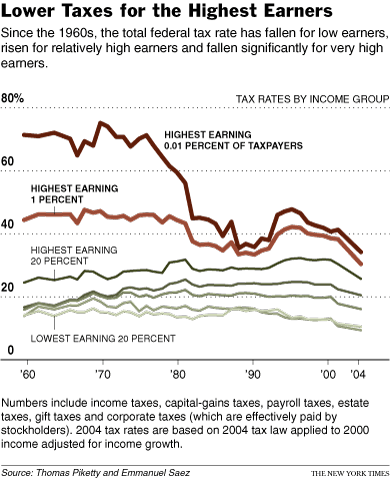
You will note in the chart above that, while income taxes have remained basically flat for most Americans over several decades, they have been systematically reduced for the wealthy during this period. The actual picture is even more dramatic, as the majority pays higher taxes now in the form of payroll taxes and sales taxes. Anybody remotely familiar with the economic history during the period knows that the greatest period of wealth creation and the highest standard of living for most Americans was during the period 1950 through the early 1970s. The period between 1970 through the early 1990s were periods of instability and declining standard of living. Now, if, as the anti-tax advocates claim, high taxes were bad for the economy, the opposite would have been true. The economy would have performed poorly in the period between 1950 and the early 1970s, and would have improved with each reduction in taxes. Given the low level of taxation in the 1980s, the economy should have been better than it ever was. But this is not what happened.

When did our economic troubles begin? They began in the early 1970s following the first major reduction in the top marginal tax rates in the 1960s. The 1970s were a period of economic instability and rising inequality. At the start of the decade of the 1980s, taxes were again slashed. The effects were extremely high interest rates and a dramatic rise in unemployment. Later in the 1980s, taxes were cut again and the economy tumbled into a deep recession. Only when taxes were raised in the early 1990s did the economy tack off. Look at this chart: 

Why did the tax increases in the 1990s kick off one of the longest periods of business expansions in US history? In part because lower budget deficits drove down interest rates, which allowed for more investment, growth in jobs, growth in consumer spending. The expansion would have been more successful if the budget surplus, which reached record levels under Clinton, had been invested in public projects to improve the long-term health of the economy. Raising top marginal rates even more would have made the expansion even more successful still. This should have been a period of economic contraction, according to the theory of the anti-tax propagandists. But it wasn’t. What happened when taxes were slashed under Bush Junior? Did, as the anti-tax propagandists claim, the economy take off? The economy tumbled. We are now in the middle of the worst economic catastrophe since the great depression. The massive budget deficits and accumulation of wealth among capitalists and their functionaries has crippled our economy. 

Facts and logic show us the way out of the crisis: dramatically raise taxes on the wealthy, redistribute that money to the masses through public projects that will improve the long-term health of our society. What do the anti-tax ideologues say? They say raising taxes in a recession is the worst possible thing to do. But, as you can see, this claim is based on the false claim that tax cuts grow the economy. The question for policymakers now is whether they act based on the facts, or act on the basis of the propaganda of the capitalist class.

Ask God what Your Grade is

After a presentation in Speech 101, in which Los Angelese City College student Jonathan Lopez read the dictionary definition of marriage and then two verses from the Bible, Lopez found an evaluation form left in his backpack by Professor John Matteson that said, “Ask God what your grade is.” This pulled a hardy laugh out of me. 

Lopez’s feelings were hurt. But why not ask God? If Lopez believes Yahweh is the final authority on gay marriage, then why not believe Yahweh is the final authority on his grade? After all, the rest of Lopez’s speech was all about the miracles Yahweh performed in his life (apparently one of which was not allowing him to escape Speech 101 without criticism for his bigotry).

Conservatives are claiming that Matteson violated Lopez’s free speech rights. But it’s more like conservatives, believing Lopez has a right to use a classroom assignment to spread hatred, and that rules of logic and evidence aren’t relevant in a college classroom, are the problem. Sure, you can cite the Bible if you wish. But you must also be aware that there may be a reasonable person in the audience. 

One student in the class said, “I do not believe that our classroom is the proper platform for him to spout his hateful propaganda.” Another student said, “I don’t know what kind of actions can be taken in this situation, but I expect that this student should have to pay some price for preaching hate in the classroom.”

These complaints are worth entertaining. Suppose Lopez had stood before the class and read the dictionary definition of race and then verses from the Bible to advocate for racial segregation or genocide. It’s easy to find scriptural support for such hateful beliefs and actions. Is it not the same thing as denying homosexuals equal protection before the law? Or is it because hating homosexuals is not perceived as quite as terrible as racism and genocide?

Matteson also has free speech rights. He used them to criticize Lopez’s presentation. 

Obama Turns not to Roosevelt, but Carter

Obama asserted in his inaugural speech that our “badly weakened” economy is the result of “our collective failure to make hard choices and prepare the nation for a new age.”

What was the hard choice working people should have made to prepare the nation for a new age? Are workers really to blame for this mess? Or are persons in positions of power? You can only hold people accountable for the things under their control.

The President of the United States has not always blamed the public for the crimes and failings of elites. In his 1933 inaugural speech, Franklin Delano Roosevelt opened with a promise to “speak the truth, the whole truth, frankly and boldly” and then proceeded to blame “the rulers of the exchange of mankind’s goods.” He said that they “have failed, through their own stubbornness and their own incompetence,” to properly lead the nation.

“Practices of the unscrupulous money changers stand indicted in the court of public opinion, rejected by the hearts and minds of men,” the thirty-second president said, attacking the rulers of exchange as only knowing “the rules of a generation of self-seekers.” (Polls regularly show that more than 80 percent of Americans today believe corporations have too much power.)

“They have no vision,” FDR said of the corporate leaders; “and when there is no vision the people perish.”

FDR preached about “the moral stimulation of work,” contrasting it with “the mad chase of evanescent profits,” and asserted that the restoration of our ideals “lies in the extent to which we apply social values more noble than mere monetary profit.”

(Read the speech here: First Inaugural Address, 4.3.1933. This is the speech Americans deserved this week, not this: Obama’s Inaugural Address.)

In the speech on Tuesday, Obama talked about “greed” and “irresponsibility” without identifying the culprits. When he identified the party at fault, he implicated everybody.

In contrast to Roosevelt, who argued that the problem was not the spirit of America but the material failure of the economic system, Obama said (after talking about “the indicators of crisis, subject to data and statistics”):

Less measurable but no less profound is a sapping of confidence across our land — a nagging fear that America’s decline is inevitable, and that the next generation must lower its sights.

He blamed the people’s spirit.

Recall Carter’s words from the notorious “malaise speech” of 1979:

The threat is nearly invisible in ordinary ways. It is a crisis of confidence. It is a crisis that strikes at the very heart and soul and spirit of our national will. We can see this crisis in the growing doubt about the meaning of our own lives and in the loss of a unity of purpose for our Nation.

Roosevelt charged that the money lenders were “pleading tearfully for restored confidence” after losing “the lure of profit to induce our people to follow their false leadership.” Obama, like Carter, like the false leaders Roosevelt assaults, accuses the public of losing confidence in their country.

Obama turns not to Roosevelt in this time of crisis, but to Carter, who failed to show the courage necessary to challenge corporate power on behalf of the nation that elected him.

Workers are not to blame. Workers woke up every morning over the last several decades and did the right thing all day long (in the context of the prevailing economic system, a system they were told was just and fair). It’s not their fault they’re being thrown out of work and home. The “rulers of the exchange of mankind’s goods” are to blame.

Roosevelt spoke the truth without advocating the overthrow of capitalism. Why can’t Obama? Why couldn’t Carter? Why must the victims of economic calamity bear the brunt of austerity? Where is the critical analysis from the media watchdogs who are supposed to keep the politicians honest?

Roosevelt said in the spring of 1938:

Unhappy events abroad [the rise of fascism in Italy and nazism in Germany) have retaught us two simple truths about the liberty of a democratic people. The first truth is that the liberty of a democracy is not safe if the people tolerate the growth of private power to a point where it becomes stronger than their democratic State itself. That, in its essence, is fascism — ownership of government by an individual, by a group or by any other controlling private power.

The second truth is that the liberty of a democracy is not safe if its business system does not provide employment and produce and distribute goods in such a way as to sustain an acceptable standard of living. Both lessons hit home. Among us today a concentration of private power without equal in history is growing.

Roosevelt didn’t just assert these facts but provided a detailed statistical analysis of the situation: One-tenth of one percent US corporations owned 52 percent of all corporate assets and received 50 percent of all corporate income in the 1930s. Less than 5 percent of US corporations owned 87 percent of the assets and less than 4 percent of manufacturing corporations received 84 percent of their net profits. In 1929, three-tenths of the population received 78 percent of dividends. In 1933, 33 percent of all inheritances went to 4 percent of heirs.

Roosevelt’s New Deal pushed back corporate power and redistributed income. He opened the way for the normalization of organized labor and the creation of a broad middle class. Educational opportunities were expanded. Poverty plummeted from 33 percent in 1950 to less than 12 percent by the end of the 1960s. Home ownership grew.

But big capital fought back, gaining strength over the decade, buying off our leaders, crushing labor, shrinking the middle class, taking control of both political parties. Corporations are now more powerful that before – capitalism has colonized virtually every aspect of our lives and its reach is global. Roosevelt’s statistical profile reads like that of the present day. And his warning sounds like prophecy.

More than ever the supporters of capitalism – for the capitalists themselves are driving the system into the ground – need Roosevelt’s words and deeds. But they get instead Carter’s rhetoric, Clinton’s cabinet, and operatives from the Federal Reserve, World Bank, and IMF.

Was this the change those who voted for Obama were expecting?

Give the Football, Jesus

“This is the source of our confidence – the knowledge that God calls on us to shape an uncertain destiny.”

So Barack Obama’s god, a male god named Yahweh, who myth contends created the universe and sent his only begotten son (Jesus) to die for the sins of Obama’s congregation, sets before his worshippers no certain destiny. He created the universe so that his worshippers could make history, and it is, according to Obama, belief that their god has no definite plan that is the source of the worshipers’ confidence.

Not exactly something that should fill the faithful with confidence, it seems to me. Belief in a god or gods, if it is anything at all, is the need for certainty when everything else is uncertain. The idea that the people need to make their own destiny is disconcerting to those who pray for Yahweh to tell them what to do.

How will those Christians, Jews, and Muslims who believe Yahweh has worked out a destiny – revealed, albeit in murky phrases, in prophecies – feel about Obama interpreting the theology of the People of Book in this way? Many Muslims incessantly repeat “god willing” because they know nothing happens without Allah wishing it to. Kurt Warner, quarterback of the Phoenix Cardinals, after winning the conference championship, said that his team won because his “Lord up above…knew [he] was going do it” and, he added, he had to win it because of that.

Indeed, if Yahweh is omnipotent, if he is able to create the universe out of his imagination, then how can the future be uncertain? Why does he need human beings to shape a destiny? Don’t they need to simply realize that destiny by following Yahweh’s commandments? Would Yahweh allow human beings to make choices that in the end destroyed them and his creation?

If Yahweh made the universe and controls the universe he made, then Barack Obama is president because this is what Yahweh wanted. Everything that happens happens for a reason, Christians are fond of telling me. John McCain did not win because this was part of Yahweh’s plan. Donovan McNabb and Philadelphia Eagles lost to the Cardinals because Yahweh wanted Kurt Warner to win. Nobody knows beforehand what Yahweh wants. Afterwards we know, because if he had wanted things to be another way, then he would have made them that way. There is no uncertain destiny because Yahweh by definition knows all. History can never be something other than what it is.

Obama disagrees with those who believe Yahweh has a plan. Does he disagree with those who believe – as did George W. Bush – that Yahweh calls on certain people to realize his plan?

Obama’s position presents a logical problem for those who claim Yahweh is omnipotent. Yahweh must know what Obama and his congregation will do (even if he lets them do it, he still knows what they will do, therefore there is no uncertain destiny) or Yahweh is not omnipotent. If it is the latter, then it follows that Yahweh is a limited god. He’s not all powerful. He doesn’t control everything.

Then what – or who – does?