Academic Freedom and the Historical-Comparative Method

Academic freedom is the lifeblood of the academy. Without the freedom to make interpretations and draw judgments about the empirical and conceptual materials in front of them, intellectuals can’t do their work. The desire to censor objectionable materials and punish the professors who present them is not the work of rational minds but of ideologues who wish to put the university in the service of state and other projects—in the case of the persecution of Bill Robinson, the project of a foreign power. We must not allow the university to become any more of a tool of the elite, foreign or domestic, any more than it is already.

Historical comparison is standard method in both social science and historiography, and comparisons may involve historical facts, documents, photographs, art, music, religious ideology, and so forth. One compares cases to theorize and test hypotheses concerning the causal forces and processes underpinning social phenomena. For example, one may compare revolutions to test the hypothesis that, for example, a weak state is the main factor in successful social revolutions. In making such comparisons it is understood that the cases are not identical, rather that they have differences and similarities.

In the Robinson case, the professor forwarded a comparisons between the Warsaw and Gaza ghettos, the experience of the victims (Jews and Palestinians), and the behavior of the oppressors (Germans and Jews). Both cases were the result of ethnonationalist projects and the similarities are too numerous to document here (view the materials for yourself and study the cases—any objective observer will find the comparison apt). To be sure, there were differences. Of course. But the differences do not eradicate the similarities.

In What Moral Universe are People Living?

Some members of groups who are driven from their homes and off their land into ghettos or onto reservations, denied their freedoms, daily humiliated and periodically massacred, have been known to take violent action against their oppressors. Native Americans sometimes responded to European colonists in violent ways, which the colonists used to justify colonization and genocide. Blacks sometimes violently resisted the policies of the National Party in South Africa. I could provide many other examples. Jewish resistance in Poland is an apt one. It’s a very old pattern. Anti-colonial violence is the consequence of colonialism.

Even when anti-colonial resistance in Palestine dies down (which is remarkable given the conditions Palestinians have been forced to live under for decades), Israel provokes Palestinians to violence. After Israel pulled out its colonists in 2005 (a result of Palestinians’ increasingly successful resistance tactics) and the Palestinians exercised their choice and elected Hamas, Israel blockaded Gaza. Hamas responded to this act of war with rocket and mortar attacks. Israel used these actions to justify bombing and launching several raids into Gaza killing scores of Palestinians.

Palestinians negotiated a ceasefire with Israel June 19, 2008, and rocket and mortar fire dropped to the single digits during these months. In fact, in September and October the number of rockets fired into Israel dropped to one per month. Overall, there was a 98% reduction in rocket and mortar attacks. The rockets that were fired were from groups in opposition to Hamas. Israel did not live up to its end of the bargain, which was to end the blockade of Gaza. Then Israel violated the ceasefire in November by launching a raid into Gaza killing six Palestinians. When some Gazans responded to this provocation, Israel used this action to justify the Gazan Massacre. Even after Israel violated the ceasefire, Hamas attempted to renegotiate. But it was election season in Israel, and politicians needed to look tough.

Finally, while it’s true that international law recognizes the power of countries to control their borders, it does not recognize the “right” of countries to control the borders of other countries or territories not legally under their authority. When a country controls the borders of a territory, then that country effectively occupies that territory.

Israel controls more than the borders of Gaza. As news stories out today demonstrate, Israel has decimated Gaza’s fishing industry by progressively ratcheting down Gaza’s freedom to fish its own territorial waters. Israel restricted Gaza to twenty miles, then to ten, then to three nautical miles, where it stands today. The fishing industry employed 45,000 of the 1.4 million Palestinians in Gaza (the majority of which are refugees). With the disappearance of the industry, one of Gaza’s few sources of protein is disappearing, and since Israel restricts food aid into Gaza, Palestinians are among the most malnourished people in the world.

Resistance to this situation is grounds for more oppression? In what moral universe are some people living?

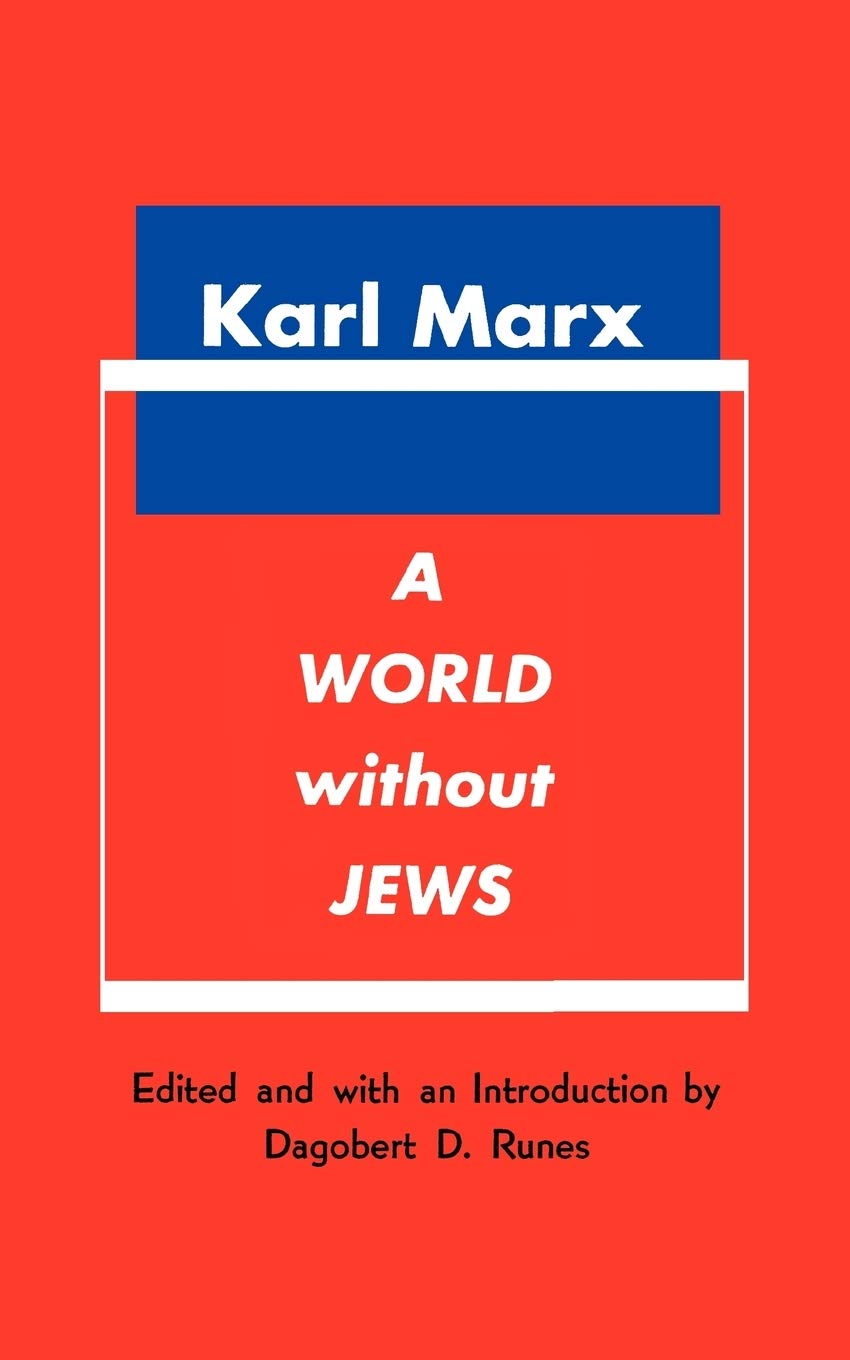
A World Without Jews

Dagobert D. Runes writes,

Karl Marx was not only born a Jew; he came from a rabbinical family. His father Heschel Marx accepted Christianity in 1816 in order to practice law in Prussian territory. Like many converts, Marx found it necessary all his life to justify the mass conversion of his family by attacks against his blood brothers.

Runes wrote this in the forward to a A World Without Jews, a book attributed to Karl Marx, published in 1959. But Karl Marx never wrote a book called A World Without Jews. Moreover, the essays that form the chapters of this book are collected from essays published separately, and include passages that do not appear in previously published versions.

Karl Marx did not write this book.

Focusing on the above quoted passage, there are two problems with it. The first is the wrong of classic psychological ad hominem. To suppose Marx was psychologically motivated to criticize Judaism and the role of Jews in European society, whatever the reason, is a fallacious argument form. Marx’s argument in the essay is well constructed and, assuming someone with the same intellect, a criticism a man or woman of any ethnic background could make.

The second problem is this phrase “blood brothers,” as in Jews are blood brothers and therefore a Jew who criticizes Judaism is a race traitor. Runes is here embracing the racialization of Jews, an imposition upon Jews by non-Jewish Europeans who sought to make them something other than Europeans. This is the wellspring of anti-Semitism. Jews are Jews by blood. Jewish blood must be something different than non-Jewish blood. This means that creating a Jewish state in Palestine is the creation of a racial state.

The bulk of the argument Marx is making is found in the 1844 essay “On The Jewish Question” in Deutsch-Französische Jahrbücher. It which was a response to Bruno Bauer’s 1943 book Die Judenfrage (The Jewish Question). Bauer’s book is complex, and I may return to a discussion of it on a later date, but the substance of Marx’s argument written in the context of his critique of Bauer is that liberation from religion would mean liberation from Jews, Christians, Muslims, etc. Marx was an atheist who advocated overthrowing the world order—capitalism—that underpinned modern religious ritual. A world without religion and capitalism would be a world without Jews because Judaism is a religion. The same would be true for Christians and Muslims. And so on. In other words, the argument is not anti-Semitic but rather anti-capitalist and irreligious. Indeed, Marx argued on behalf of Jewish liberation in Germany.

Sotomayor and the Belizean Grove

US Supreme Court nominee Sonia Sotomayor on Friday resigned her membership in an all-women organization, hoping to head off criticism that she belonged to a discriminatory organization before her confirmation hearings begin next month.

President Barack Obama nominates Judge Sonia Sotomayor

The group, the Belizean Grove, calls itself “a constellation of influential women” formed in response to the all-male Bohemian Club, whose annual revels at its expansive Northern California estate are attended by powerful and influential men.

The Belizean Grove apparently doesn’t own its own property, but schedules periodic events in the US, Belize, and other locations in Central America, according to its Web site.

“I believe the Belizean Grove does not practice invidious discrimination and my membership did not violate the Judicial Code of Ethics, but I do not want questions about this to distract anyone from my qualifications and record,” Judge Sotomayor wrote in a letter to Senate Judiciary Committee Chairman Patrick Leahy, a Vermont Democrat, and ranking Republican, Sen. Jeff Sessions of Alabama.

“The Belizean Grove is proud and privileged to have had Sonia Sotomayor as a member,” Susan S. Stautberg, the group’s founder, said in a statement. “We’re all sorry that she is not able to continue.”

A Senate Republican aide said Republicans didn’t plan to object to Judge Sotomayor s membership in the group, but did hope to contrast their position with Democrats, who in past years have criticized Republican judicial nominees for membership in all-male clubs.

George Richard Tiller (1941–2009)

It doesn’t matter how many abortions Tiller performed or at what point during the pregnancy he performed them or whether the fetus had birth defects or how much money he made performing abortions or whether the fetus is a person or the motives behind the desire to seek an abortion. All this is beside the point. An abortion is a private matter between the doctor and the patient. In a free society, women decide whether to have children. Not the state. Not the father. Not the church. Nobody else and no other entity can make that decision for women while at the same time maintaining the personal sovereignty of women. Tiller helped tens of thousand of women realize their personal liberty by empowering them to determine for themselves if and when they should use their sovereign bodies to multiply the numbers of persons on earth. The state didn’t decide for them. They state forced them neither to have a baby nor to have an abortion. That is how it should be in a free society. What matters in this case is that a terrorist from a so-called movement calling itself “pro-life,” but which is in fact a extremist countermovement aiming to deny women sovereignty over their bodies, assassinated a doctor in the foyer of his church.

Anybody who says that the state must force women to have babies – and this includes everybody who believes abortion should be restricted by local, state, or federal government – either does not love personal liberty or does not understand what personal liberty means and why it is imperative to preserve it if we are as a people to be free. At its core, the anti-choice countermovement is the authoritarian desire to place the womb under state control, to control women by controlling their reproductive capacity. It is, whether conscious of itself or not, a desire to enforce by law the essence of patriarchal domination. Tiller, and all those other doctors assassinated by anti-choice extremists, are the victims of terrorism. These terrorists, these religious zealots who desire theocracy, hate our freedoms. They hate our way of life.

Abortion is not an issue where reasonable people can agree to disagree. Either we defend the right of women to control their own bodies or we cave to tyranny. Control over one’s body is a fundamental human right. There is no compromise.

“Racist, Fascist” Bills

Right wing Knesset members, led by Foreign Minister Avigdor Lieberman and his ultranationalist party Yisrael Beiteinu, have proposed a bill to outlaw commemorations of the al-Nakba, the catastrophe that befell hundreds of thousands of Palestinian Arabs who were expelled from their homes by Jews in the 1948 wave of ethnic cleansing, a key moment in the construction of a Jewish Zionist state. Israel’s Arab citizens, along with Palestinians in the diaspora, recognize al-Nakba on May 15, the day following the end of the British mandate over Palestine in 1948. Arabs commemorate that day by parading through villages destroyed by Jewish colonizers. The bill, if made law, would ban these commemorative practices with a prison term of up to three years for anyone participating in them.

Bill Robinson, professor of sociology at the University of California-Santa Barbara, recently pointed out about this law “criminalizing acts of memory, of collective identity, of cultural and political expression.” “Imagine criminalizing black commemoration of slavery, or Indian commemoration of genocide in the Americas?” He said. “Or Jewish commemoration of the Holocaust?” Indeed. Can you imagine that? Yet those who commemorate the Holocaust are proposing to forbid Arabs from commemorating al-Nakba.

This isn’t the only fascistic measure. As reported in Haaretz, the Knesset plenum has given its initial approval to a bill that would make it a crime to publicly deny Israel’s right to exist as a Jewish state. This “crime” would be punishable by a prison sentence of up to a year. This means that an Arab Muslim, in an alleged democratic society, could not voice the opinion that Israel has no right to exist as a Jewish state. This is analogous to a law that makes punishable any public denial of the right of the German state to exist as a white non-Jewish racial state. Can you imagine a Jewish citizen of Germany being forced to keep quiet his protest of the exclusive ethnic character of his state?

Moreover, a third bill, proposed by David Rotem of the Yisrael Beiteinu, would require any persons seeking Israeli citizenship to swear an oath of loyalty to Israel. This bill reads: “those seeking citizenship will be required to declare commitment to be loyal to the state of Israel as a Jewish, Zionist and democratic state, to its symbols and its values and to serve the state as required in military service or an alternative service.” Imagine an Arab Muslim, in order to be a citizen in an alleged democratic country, swearing his allegiance to a Jewish Zionist ideal, its flag and others symbols, its values, which include its religious and ethnic character, and to serve in a compulsory fashion that state even when its policies are detrimental to Arab Muslims.

Similar bills propose amendments to the laws that governs the oath taken by Knesset members and members that includes identical language. Thus an Arab Muslim elected to the Knesset would be requires to swear his allegiance to a Jewish Zionist state. Here’s the Haaretz piece: Israeli Arab committee slams ‘racist, fascist’ bills.

Christian Zionism

Counterpunch published a story today, “Bush, God, Iraq and Gog,” by Yale professor Clive Hamilton, about George W. Bush, lobbying leaders to put together the “Coalition of the Willing” in 2003, telling French president Jacques Chirac that Yahweh’s will was at work in the world, and that mythical apocalyptic creatures of the ancient Hebrews, Gog and Magog, were rising to threaten Israel. Bush was on a mission from God to vanquish them. “This confrontation is willed by God,” Bush told Chirac. God, Bush said, “wants to use this conflict to erase his people’s enemies before a New Age begins.” Bush told Chirac that “the biblical prophecies are being fulfilled.”

Gog and Magog are mentioned in both Genesis and Ezekiel of the Old Testament, and famously in Revelations 20:7-8: “And when the thousand years are expired, Satan shall be loosed out of his prison, and shall go out to deceive the nations which are in the four quarters of the earth, Gog and Magog, to gather them together for battle: the number of whom is as the sand of the sea.” (By the way, George H. W. Bush’s nickname in the Skull and Bones at Yale was “Magog.”)

Élysée Palace turned to a theologian at the University of Lausanne, Thomas Romer, and find out what Bush was talking about. It’s Romer who provides the first account of this revealing movement, published in an article by Jocelyn Rochat, “George W. Bush et le Code Ezéchiel,” in Allez Savoir! (No. 39, September 2007). Since the account was written in the French language, it long escaped scrutiny by US observers (much like Zbigniew Brzezinski admission in Le Nouvel Observateur, Jan 15, 1998, that the Carter administration played the key role in turning Afghanistan into a cesspool to destabilize the Soviet Union and that he had no regrets about being responsible for the fundamentalist Islamic terrorist networks operating today). Chirac has corroborated Romer’s account in a book by Jean Claude Maurice, Si vous le répétez, je démentirai, published in March of this year.

In his article, Anderson writes, “There can be little doubt now that President Bush’s reason for launching the war in Iraq was, for him, fundamentally religious. He was driven by his belief that the attack on Saddam’s Iraq was the fulfillment of a Biblical prophesy in which he had been chosen to serve as the instrument of the Lord.” Indeed. It was a crusade in Bush’s mind. But we didn’t need to wait for this new piece of evidence to know this. Readers familiar with my work will recall that I exposed Bush’s motives to an international audience in my article “Faith Matters: George Bush and Providence,” published in The Public Eye on March 18, 2003, two days before the Iraq invasion.

(This article landed me a interview with public radio and the first invitation to speak at the United Nations University in Amman Jordan. There was a funny moment in the discussion period following my 2006 presentation in Amman, Jordan, at the United Nations University. I shared the stage with, among others, Shlomo Avineri. For those of you who are not familiar with Avineri, he is the famous Israeli political scientist noted for landmark works on Theodor Herzl, Moses Hess, and Zionism, and the political and social thought of Hegel and Marx. He also did considerable political work in negotiations in the Middle East countries on questions of science. It the work on Marx that first introduced me to Avineri. When I finished discussing the role of Christian Zionists in the Middle East, Avineri quipped, “This is help we don’t need.”)

On the Importance of Making Historical Comparisons

I am happy to see Professor Hajjar defend Robinson’s academic freedom (and thus hers) even though she would not herself have made the comparison. She provides a model for all to follow. If we prize an open democratic society, we should all defend academic freedom, as well as the freedom of speech we all enjoy, even for relevant speech with which we disagree.

However, I don’t agree with her statement, “You don’t evoke Nazis unless you’re talking about Nazis.” That’s a poorly formed thought. The email evokes the Nazis for the purpose of comparing oppressive state tactics carried out against marginalized peoples. This is a legitimate exercise.

What are the reasons for not evoking Nazis unless you are talking about the Nazis? Because it is mistaken? Should we then stifle a social scientist who compares Iran to Nazi Germany even though such a comparison is rather obviously erroneous?

It is quite obvious that we can’t debate whether the comparison is erroneous if we are not allowed to evoke it. This is the purpose of the classroom (and other academic fora). Should the comparison be disallowed because the Jewish holocaust is a sacred case? Are we going to make a list of sacred cases disallowed in historical comparison? Who will make this list—this “Index of Prohibited Historical Comparisons”?

Doesn’t making exceptions run contrary to the goal of objectivity in science? The Catholic Church allowed Galileo to discuss many of the things he was discovering about our solar system. But when it came to the question of geocentrism, which the Catholic Church felt delegitimated its dogma, the Church drew the line. We all recognize now that was inappropriate. We should all understand the motive of the Church. We cannot similarly make an exception for arguments comparing the tactics of the Israeli regime against the Palestinians to the German Nazi tactics against the Jews.

The dangers of artificially constraining comparisons should be obvious. The Nazis were not the only regime in history to have perpetrated genocide. The Jews were not the only victims of genocide. Yes, the Nazi case is unique. But all genocides are unique cases taken in terms of their own particulars. Taking cases in themselves doesn’t help us fully explain them and, crucially, prevent them from happening again. Many observers, including many of Jews, have suggested something like the Jewish holocaust could happen again.

The point of comparison is to identify similarities and dissimilarities and generalize patterns to theorize common causes and dynamics. There can be no science without comparison, and science is inappropriately limited when certain cases are for non-scientific purposes excluded from analysis. Here’s the article to which I commented: Panel Defends Robinson.

NPR’s Special Segment on Anti-Semitism

Bill Robinson’s case prompted a discussion of anti-Semitism on NPR Talk of the Nation. Here’s the blurb from the program dateline May 18, 2009:

A California professor stirred up a backlash when he compared Israelis to Nazis. Monday, as Israeli Prime Minister Benjamin Netanyahu meets with President Obama, Neal Conan talks with guests and callers about the question: What is anti-Semitism? Guests are: Nicholas Goldberg, deputy editor of the Los Angeles Times editorial pages, whose article “What Is Anti-Semitism?” appeared last week; John Mearsheimer, University of Chicago political science professor and co-author of The Israel Lobby and U.S. Foreign Policy; and Walter Reich, the Yitzhak Rabin Memorial professor of international affairs, ethics and human behavior at George Washington University, a senior scholar at the Woodrow Wilson Center and the former director of the U.S. Holocaust Memorial Museum.

Goldberg is the journalist who wrote the op-ed “What is Anti-Semitism?” discussed here on this blog (recall that the experts he consulted were Abraham Foxman, Alan Dershowitz, and Daniel Goldhagen). Mearsheimer was the only one who had anything worthwhile to say. But many things are revealing when the event is examined with a critical eye. Neal Conan kicked off the program with this claim:

After Gaza and the Bernard Madoff scandal, many Jews perceive a significant and disturbing increase in anti-Semitism. For example, some [two] students [in a class of 80] at the University of California Santa Barbara complained after a professor there distributed an email that compared Gaza to the Warsaw ghetto, and implicitly Israelis with Nazis.

Conan provided neither evidence nor sources for his claim. Both Mearsheimer and Reich agreed that anti-Semitism was not dramatically on the increase. Here’s Reich’s answer:

Anti-Semitism has been fairly stable during the last several years. There’s been a bit of an upsurge probably in the last months following both the economic crisis and the activities in Gaza, but in general it’s been fairly stable and has not increased markedly.

Mearsheimer took the opportunity to get to the point:

I see occasional instances of anti-Semitism, but it’s hardly commonplace. I mean, the problem that we’ve come to in the United States is that it’s almost impossible to criticize Israeli policy or to criticize the US-Israeli relationship without being labeled either an anti-Semite or a self-hating Jew. And the reason that defenders of Israel use this charge so liberally is because it is deadly effective at silencing critics and deterring other potential critics from leveling criticisms at either Israel or the special relationship that exists between the two countries.

On the question of whether Robinson’s email crossed the line, Goldberg noted that the shared view of Foxman and Dershowitz was that the claim that Israeli aggression against Palestinians is comparable to Nazi aggression against Jews is “absurd because it’s inaccurate, but it’s particularly insensitive and particularly hurtful to compare you to your own persecutors.” A reasonable follow up query would have been whether there is something remarkable about the victims of oppression using similar tactics against other peoples. Conan asked Goldberg to define anti-Semitism. He admitted it was hard, but then said this:

One of the best definitions I found was the European Union Monitoring Center on Racism and Xenophobia. This organization back in 2004 tried to come up with a working definition of anti-Semitism, and some of the things that they came up with were calling for the killing or harming of Jews in the name of an extremist ideology, making dehumanizing or demonizing stereotypical allegations about Jews, accusing Jews as a people of being responsible for wrongdoing that was in fact committed by a single Jewish person or group, trafficking in Jewish conspiracy theories, denying the Holocaust and accusing Jews of being more loyal to Israel then to their own nations. And one of the other things that the organization talked about is they said that anti-Semitism could also target the state of Israel, and they did say specifically that comparing Jews to Nazis was a form of anti-Semitism.

I want to talk about this document, produced by the European Union Agency for Fundamental Rights (really the work of its predecessor the European Monitoring Centre on Racism and Xenophobia). The report, Report on Racism and Xenophobia in the Member States of the EU, list several examples of what constitutes anti-Semitism. The part that the program focused on was this: 

Examples of the ways in which antisemitism manifests itself with regard to the state of Israel taking into account the overall context: … Drawing comparisons of contemporary Israeli policy to that of the Nazis. Holding Jews collectively responsible for actions of the state of Israel.

You will note that these statements cannot simultaneously be true. The premise of the second statement is that one cannot hold Jews collectively responsible for actions of Israel. To do so is anti-Semitic. Blaming Jews for the actions of Israel would be like blaming Muslims or Arabs for the actions of Saudi Arabia. Israel doesn’t represent all Jews, even if it claims to be a Jewish state, any more than Iran represents all Muslims, even thought it claims to be a Muslim state. Saudi Arabia does speak for all Arabs even though it’s an Arab state. Etc.

The claim made by Zionists that the movement speaks for all Jews does not mean that it actually does. Indeed, it’s rather self evident that it doesn’t. So then how can it possibly follow that comparing Israeli policies with the policies of Nazi Germany is anti-Semitic? It cannot be because Israel claims to be a Jewish state, since the report already establishes that Jews cannot be held collectively responsible for what Israel does. Israel does not represent Jews as a people. Israel cannot speak for Jews as a people. Israel is not coextensive with Jews as a people. If it were, then it follows that we could hold Jews responsible for the acts of Israel. No?

The same EU report says “criticism of Israel similar to that leveled against any other country cannot be regarded as antisemitic.” In other words, the report makes an exception for one country. That’s unethical.

Reich criticized Robinson’s use of the photograph by singling out a photo he said that, contextualized, proved the fallacy of the e-mail. 

One is a German soldier, one of the Einsatzgruppen, behind the advancing German forces in the former Soviet Union, and he’s aiming a rifle. All you see is him aiming a rifle. He’s aiming a rifle at the head of somebody who’s not in the photo because that part of the photo was cut off. He was shooting a woman in the head holding a baby. Probably it killed both of them with the same bullet. Paired with that was a picture of an Israeli soldier holding a rifle. The appearance is that they’re both doing the same thing. One was part of a murder operation that eventually killed, in that particular part of the Holocaust, one and half million Jews by executing them or gassing them. The other one was part of a war.

Reich began this by suggesting Robinson doesn’t have the requisite analytical training to know that he committed a fallacy. Ironically, assuming he isn’t being dishonest, Reich doesn’t know that Israeli soldiers have created a T-shirt glorifying the killing of an Arab mother and fetus. The image is of a pregnant Arab woman in the crosshairs. The caption reads “1 SHOT 2 KILLS.”

This evidence is devastating to Reich’s argument. It’s the equivalent to a clean knockout blow in boxing. The referee doesn’t even bother to count. Reich demonstrates his superficial understanding of these issues in another moment. A caller named Steve called in with a powerful point:

My mom was raised in racist Texas in the ’40s. And you know, she used to comment to me how she was afraid of what drinking fountain to use being a Jewish girl, you know, whether to use the white or the colored fountain, and she was called all kinds of racist names, anti- Semitic names. She taught me that to be a good Jew was to be a good person. It was basically to follow the Golden Rule. And I feel like being a Jewish person who loves people from all walks of life and all nationalities and religions, to not speak out against the collective punishment against the Palestinians, to not speak out against these brutalities, is anti- Semitic because Semites—not only the Jewish people, they are our Arabic brothers and sisters as well. And I find that when I’m speaking out against these injustices to be called a self-loathing Jew is in and of itself anti-Semitic as well. And that is my comment.

Conan asked Reich whether it is fair to call Steve a self-hating Jew? Reich responded with this bit of jazz:

I don’t like that term at all. And, you know, we tend not to know everything about everything at all times. So we act and do and believe things for the purpose of trying to feel as if we’re good people. People are demonstrating, including Jews, many Jews, against Israeli activities based on what they know, based on what they see in the media and so on. For example, last week I was in London. And there was a piece, probably an anticipation of the Pope’s visit… And it was in a Palestinian woodworking shop, and there was a close shot of a figure of Christ and I think was Christ with thorns, crown of thorns, and it moved to the Christian Palestinian. And he talked about how it was hard for him to get across checkpoints to sell his goods, as I recall. What – so there was an equation of Christ with the crown of thorns and the Palestinian—both are suffering. What the BBC reporter didn’t talk about, probably didn’t even know about, was that the percentage of Palestinians who are Christians keeps on going down. Bethlehem is now primarily a Muslim city. And they’re going down largely because they’re being intimidated and having to leave Palestine, having to leave the Middle East because of this kind of intimidation by Muslim Palestinians. He also – probably, he didn’t talk about—may not have even known why there were checkpoints in the first place. It’s very complex. But if all you see is that, if I were a Christian, I would be very upset and I would react because that was what I would think I know.

How about that for insulting Steve? First, Reich doesn’t address Steve’s point at all. He can’t because it is morally unassailable. So he changes the topic with an anecdote the purpose of which is to suggest that Steve only clings to this moral perspective because he is ignorant of what is actually happening. This style of responding to the moral argument is highly similar to the way Eliezer Wiesel answers questions like this. It is a typical tactic of defenders of Israeli brutality to change the subject and treat the questioner as a child who doesn’t know what’s going on. When the subject of the “new anti-Semitism” was suggested, Mearsheimer responded:

[I]f you look carefully at the debate about anti-Semitism today both in the United States and in Europe, I think that what you see is that the old-fashioned kind of anti-Semitism is kind of gone by the boards. And the new anti-Semitism – and that’s a phrase that’s frequently used by organizations that are fighting anti-Semitism in Europe and the United States – the new anti-Semitism has a lot more to do with Israel than it has to do with criticizing Jews. People who criticize Israel and equate Israeli behavior with Nazi behavior is seen as the main problem today. People who talk about the Israel lobby and argue that it is a powerful interest group in the United States that influences policy towards the Middle East, are oftentimes labeled as anti-Semitism. This is the new anti-Semitism. And the reason that people talk about the new anti-Semitism is that it’s very hard to find much evidence of the old-fashioned anti-Semitism that Nick was talking about before.

Finally, there is this interesting slip by Goldberg. 

I talked to Danny Goldhagen, who’s the author of Hitler’s Willing Executioners, and he said that what he listens for is—he says again, there’s nothing wrong with criticizing Israel. You can say that the aggression—I’m sorry, the Israeli incursion into Gaza earlier this year, you can criticize it, you can say it was wrong, you can say that too many civilians died, but what he listens for is, well, are you criticizing Israel exclusively?

In case you missed it, Goldberg apologizes for characterizing the Israel attack on Gaza as “aggression.” He corrects himself and uses the term “incursion.” Israel bombed with war planes a country with no anti-aircraft defenses, no air force. Israel attacked with the most advanced weaponry on the planet—tanks, helicopters, machine guns—a civilian population trapped behind walls topped with razor wire. Some 1,400 Palestinians were killed, hundreds of them children. White phosphorus rained down on human beings who were burned alive. Hospitals, schools, apartments, and houses were pulverized. An incursion is a raid, a surprise attack by a small armed group. This was no incursion. This was aggression. It was a massacre.

Constantly Getting the Facts Wrong

In a story in the Daily Nexus, which is UC-Santa Barbara’s student paper, the myth that Robinson sent the email to private student accounts is repeated. A third-year history of public policy and sociology major is quoted as saying, “While professors do have much free range to discuss the topics they may discuss, they aren’t allowed to use private email list serves of students to propagate their own agenda, like [Robinson’s] e-mail which had nothing to do with the syllabus.”

First, most of the content of a course is not on the syllabus. This is obvious. Second, the e-mail was entirely and unambiguously relevant to the course. You have to be thick or willfully ignorant to not see this. Robinson was teaching a sociology class concerned with global issues and processes. The major global issue unfolding in January was Israel’s invasion of Gaza. Robinson introduced the Gaza invasion into a sociology class concerned with global issues. It would have been ideological for Robinson to have avoided in a class of this character introducing materials to prompt discussion about the major global issue of the day.

It is the nature of social science to engage in comparison (all science, in fact, proceeds by comparison). By identifying similarities across historical cases, comparison allows the social scientists to reveal common sociological processes at work. One can see how political economic projects of a similar character at a given point in historical development and shared cultural understandings use parallel tactics to achieve their goals. So the manner in which Robinson presented the material, in the form of a historical comparison, is entirely appropriate.

Robinson’s attached commentary is designed to provoke discussion. The comparative analysis leads to a discussion of motive, effect, and justice. There are legal questions of mens rea and actus reus that pertain. Is this genocide? Is the claim that the invasion was self-defense legitimate? What is the Israeli project in Palestine? What does international law say about this? As a sociologist of globalization, Robinson is well-versed in the character of international law.

Given that the United States is heavily involved in financially supporting the Israeli project, and the United States is the global hegemon, these questions are crucial to explore in a class with the title “Sociology of Globalization.”

Third, students are automatically enrolled in the course distribution list, which every course at the university has (mine has a similar system). Robinson is not reaching into private emails. His students are enrolled in a course distribution list through which they receive course materials. If they don’t want the materials, then they can not enroll in the course. If they want to cherry pick materials, then they can delete what they don’t want to see.