A Ticket for Speech

According to the Associated Press, Linda Ramirez-Sliwinski, a trustee in the Chicago suburb of Carpentersville, was issued a 75 dollar ticket for disorderly conduct after neighbors complained to police. 

Here’s what happened. Two children were playing in a tree next door to her house. She told the boys to get out of the tree because she was worried for their safety and because the magnolia tree was small and the boys were damaging it. 

The father, who evidently doesn’t understand what a trustee is, told her that it was none of her business.

This was her response: “I calmly said the tree is not there for them to be climbing in there like monkeys.”

The boys happened to be black. The mother of one of the boys called the police. In Illinois, there is an ordinance that bans conduct that disturbs or alarms other people. The police said that one boy was scared and a mother was disturbed. 

Why isn’t everybody in a panic over calling a black male “boy”? Could it be because context is everything?

Ramirez-Sliwinski says she will fight the ticket—as she should—but that she will not seek re-election to the board.

Turns out that there’s more to the story. Ramirez-Sliwinski is an Illinois delegate for Barack Obama, a position which she has resigned. The resignation was announced by Amy Brundage, a spokesperson for the Obama campaign. 

The AP story irresponsibly states that she was “using the word ‘monkeys’ to describe black children playing in a tree.” No, she wasn’t. She was using the word “monkeys” to describe boys playing in a tree.

Meanwhile, poverty among black children is still much greater than it is among white children. When are we going to do something about that?

Obama Cruising to the Nomination

Howard Dean, the chairman of the DNC, the man who is supposed to be looking out for Democrats, says, “I think there is 800 [superdelegates], and 450 have already said who they are for. I would like the other 350 to say who they are for at some point between now and the first of July, so we don’t have to take it to the convention.”

Mort Kondrake, who would love to see an Obama candidacy, says, “The only way out of this that I can see, since there is not going to be a re-do in Michigan or Florida, is for somebody, and Phil Gretason [sic], the governor of Tennessee is trying to organize this, is a pre-convention of the super delegates—get them all together and have them decide.”

A “pre-convention”? Conventions are not supposed to be public relations affairs where the party parades around looking as if it’s unified. We don’t want stage-crafted “democracy.” Conventions are where issues are discussed and the candidate that stands the best chance of being elected president and who best represents the interests of Democratic voters is selected. Liberal elites are desperate to bring the election to a close because they’re scared witless that, by August, Obama will have self-destructed, denying them the claim of the first African American presidential candidate. 

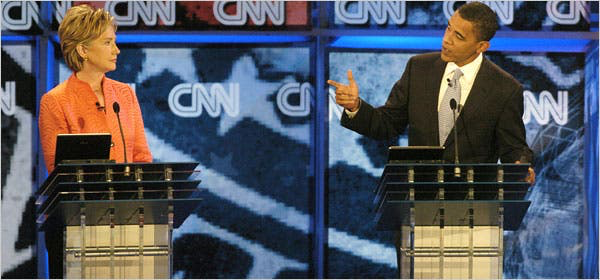
Clinton and Obama debate

Ending the primary is not what Democratic voters want. As Clinton has pointed out, two-thirds of Democrats in a recent poll want the primary process to work itself out through voting. There are millions of people who haven’t yet voted, and they want their say. Of those who want the race to end, the same percentage of Democrats want Obama to drop out of the race as want Clinton to drop out of the race. The party should take note of this fact, because, coupled with the one-third of Clinton supporters who say they will switch to McCain if Obama wins the nomination, it signals how many Democrats are worried about an Obama candidacy.

* * *

Very interesting story out today by ABC news on Philadelphia mayor Michael Nutter. I don’t agree with everything he said, but I greatly admire his standing up for substance over symbolism. He says in no uncertain language that he would have left Trinity United over Jeremiah Wright’s teachings. “I could not sit and tolerate that kind of language, and especially over a very long period of time,” he said. “If I were in my own church and heard my pastor saying some of those kinds of things, we’d have a conversation about what’s going on here, what is this all about, and then I would have to make my own personal decision about whether or not to be associated or affiliated.” When asked if he would have quit, he answered, “Absolutely.”  

Philadelphia mayor Michael Nutter

He talked about the pressure from the black community, pressure that has already caused prominent members of the black community to switch their vote to Obama. The most disappointing defector to the Obama camp was House member John Lewis, who admitted that he switched because of anger and harassment from the black community. Nutter said that he hears all the time, “Why not support a brother?” He answers, “Somehow, someway, for some people there’s an automatic assumption that a mayor who is African American or some other elected official has to support another African American.”

As for the possibility of an historic moment, he added, “Certainly the opportunity to demonstrate to my 13-year-old daughter that there is a bright future for her, that a woman could get elected president of the United States, is equally compelling.” This historic possibility has been lost on the press. Black men got the right to vote in 1870. It would take another fifty years for women—all women—to get the right to vote. There’s no rule that says race comes before gender in “historic firsts.”  

Nutter said, “Either candidate will clearly make history. But you only get to vote for one. The most important thing is winning in November, putting a Democrat in the White House.” He continued, “I’m a great fan of history. I don’t know that when people are struggling to pay the bills, that they ultimately conclude that, ‘Well, if we can just make history with this vote, then all of my problems will be solved.’”  

Nutter condemned the Democratic Party for disenfranchising voters in Florida and Michigan, two states Clinton won by large margins. The Democratic Party is refusing to seat those delegates. “Think about who we are in the Democratic Party and the country we are in,” Nutter said. “That we would somehow leave out any of our citizens in this process, I think, would be an absolute disgrace. We need to be a bit smarter about it.”

Many in the black community are confused by Nutter’s endorsement. They thought for sure that he would support Obama. Instead of scratching their heads, however, they should listen to what he said and realize that his endorsement is rooted in reason, a commodity in short supply among those caught up in Obamamania. What Nutter says about electability is on point.

* * *

A great many democrats have been sucked into the Obama cult of personality, and, with virtually every media outlet claiming that Obama’s speech on race was historic and satisfying in terms of addressing the outstanding problems of his association with Jeremiah Wright (without going into detail about Obama’s close association with James T. Meeks and Salem Baptist and other black leaders of Wright’s ilk), it’s not particularly surprising that a majority of Democrats have come to this conclusion. After all, Obama is winning the election. Democrats needed a reason to justify their vote and the corporate media handed it to them. It’s all hunky dory now.

As for Republicans, their responses are for the most part a combination of subconscious fear of being perceived as racist by interviewers (many respondents, especially those who perceive interviewers as having reason to suspect them of racialized politics, are deceptive with interviewers in polls when race is a factor), a deep-seated hatred of Clinton that has them convinced that there is no way Clinton can be a strong candidate (they don’t know anybody who would vote for Clinton, so how could most Americans?), and a press so completely in Obama’s camp that they are convinced that McCain won’t be covered fairly in the general election if Obama is the candidate.

Given everything we can plainly see about the circumstances surrounding this poll, the results are predictable. More accurate are polls asking Clinton supporters whether they will support Obama or McCain in the event Clinton doesn’t get the nomination. The finding that one-third of Clinton supporters will support McCain given such an outcome is a much clearer indication of the possible consequences of an Obama candidacy. Numbers to this question put to the Obama side have risen of late because Obama supporters, frustrated by Clinton’s reluctance to quit in the middle of the fight, have turned on her (when the question was first asked, only a small proportion of Obama supporters would switch parties given the opposite scenario).

If the polls ever switch in Clinton’s favor, it will happen despite the overwhelming force of the corporate media’s surreal push for an Obama’s candidacy. Moreover, with Obama contributing so much money to the campaigns of superdelegates, who, more than 80 percent of the time support the candidate who contributes the most money to their campaign, it looks bleak for Clinton.

Disloyal Obama’s Duplicity

Bill Burton, a key Obama adviser, when asked why Obama disinvited his spiritual mentor Jeremiah Wright to speak at Obama’s presidential race kick off, said, “Senator Obama is proud of his pastor” and that Obama wanted to “avoid having statements and beliefs” of Wright show up on blogs and conservative talk shows. So Otis Moss III was asked to speak instead. Of course, Moss’s statements and beliefs are no different from Wright’s, but then the media hasn’t pursued that. They have made this about Wright, because they believe they can—as Obama has done—dismiss him. But it’s not about Wright; it’s about Trinity United Church of Christ and black liberation theology.

At the time, Al Sharpton criticized Obama over the disinvitation saying that blacks were rightly distressed by Obama failing to stand by his pastor. Sharpton doesn’t make this criticism any more, even though Obama has failed to stand by his pastor in even more dramatic fashion as of late.

Wright understood why Obama distanced himself from church teachings. “When his enemies find out that in 1984 I went to Tripoli [to visit Muammar el-Qaddafi] with [Louis] Farrakhan,” he said, “a lot of his Jewish support will dry up quicker than a snowball in hell.” Wright also knew that such statements as the following one could prove fatal to Obama (if, of course, the media ever harped on them): “White America and the Western world came to realize [in the wake of the 9-11 terrorist attacks] that people of color had not gone away, faded into the woodwork or just ‘disappeared’ as the Great White West kept on its merry way of ignoring Black concerns.” (I guess I don’t really need to point out that this quote hasn’t been discussed at all in the current discussion over Wright’s teachings, even though it is a well known among those who are paying attention.)

Obama knew full well the character of Wright’s language, telling Wright during the disinvitation conversation: “You can get kind of rough in the sermons, so what we’ve decided is that it’s best for you not to be out there in public.” For those slow on the uptake, this means that Obama is lying when he says he was unaware of the controversial remarks. Clinton’s misremembering of events during one hour 12 years ago in a war zone goes to the heart of her trustworthiness, we are told, but no similar claim is made about Obama’s continuing and deliberate deception in hiding his spiritual mentor from the public and denying that he heard controversial remarks (a story Obama can’t keep straight).

This really is the story: Obama’s lying. But the media isn’t reporting the story this way. The corporate media angle is that his speech was the best speech ever on race and Americans for the most part believe he addressed their concerns. The media doesn’t provide the proper angle because, as it is as obvious as anything could be at this point, their goal is to see to it that Obama gets the nomination. Whether their overwhelming support for Obama stems from the desire to ameliorate the guilt they feel as whites over racism or sabotage Hilary Clinton’s chances is a matter of interpretation. (Maybe it’s both.)

Wright has cancelled many of his appearances of late, one suspects because the attention they would receive would prove embarrassing to Obama. But one wonders why Wright, who once said that Obama was “the hope of the world,” continues to do Obama’s bidding. Wright warned both Obama and Moss years ago that an Obama presidential campaign would make criticism of Trinity inevitable. I’m sure he didn’t expect Obama to turn his back on the church and reduce its preacher to a crazy old uncle who says bizarre things when that inevitability manifested itself in the clips of Wright’s sermons shown on YouTube.

Obama now says he would have quit the church if Wright hadn’t retired. “Had the reverend not retired and had he not acknowledged that what he had said had deeply offended people and were inappropriate and mischaracterized what I believe is the greatness of this country, for all its flaws, then I wouldn’t have felt comfortable staying there at the church.” But that’s not what Obama said in the “greatest speech ever.” Remember what he said then? “I can no more disown him than I can disown the black community. I can no more disown him than I can my white grandmother.” 

Obama can’t get his story straight. He says he never heard controversial remarks despite being a member of the church for twenty years. Then he says in his speech he did hear controversial remarks. Then he says after his speech that he didn’t hear controversial remarks, that he wasn’t there those days. Then we learn that he didn’t let Wright speak at the ceremony announcing his run for the White House because of Wright’s controversial statements. He says Wright is family and he can’t disown him and that’s why he didn’t leave the church. Now he says that had Wright not retired he would have left the church.

Obama knows that, if white America ever realizes that for two decades Obama faithfully, willingly, and enthusiastically attended a church where the minister preached the things Wright preached week in and week out, Clinton will likely be the nominee of the Democratic Party. But the truth is that this is exactly what happened. So rather than simply admit it and take this opportunity to explain to America what Trinity United is all about, Obama lies. And the media covers and spins.

Wright and Trinity United got attention a while back when another member of the church, Oprah Winfrey—who says that “Obama is the one we’ve been waiting for” (The Matrix?)—actually stopped attending the church (she hasn’t been a member for nearly a decade), because she didn’t like Wright’s rhetoric—again, rhetoric Obama has always known about but which he denies knowing. Wright didn’t take Oprah’s leaving well. When asked about it, he said, “She has broken with the (traditional faith)…. She now has this sort of ‘God is everywhere, God is in me, I don’t need to go to church, I don’t need to be a part of a body of believers, I can meditate, I can do positive thinking’ spirituality.’ It’s a strange gospel. It has nothing to do with the church Jesus Christ founded.”

Although Obama never left the church, he has turned his back on the church’s teachings. As readers of my blog know, Wright advanced what he called a “Black Value System,” one of the tenets of which is the rejection of “middleclassness.” This value issues from the Marxist character of black liberation theology. Obama has fully embraced the middle class lifestyle, pitching his campaign specifically to the middle class voter—the white affluent college-educated liberal who wants desperately to vote for any black man to prove to themselves that anything is possible in America. Working people (except working class blacks, who are tragically voting on the basis of identity politics and not on the basis of their objective interests during this campaign season) get this and therefore are supporting the candidate with the practical policy and program proposals (who has the added bonus of potentially beating McCain in November).

You can’t trust Obama. He has either sold out completely or he was always lying to the south side of Chicago. In any case, he has been lying to Americans all along and he won’t stop lying about all of this.

Obama is getting a free ride from the corporate media. Obama tells the public that any statement his preacher made that offends them he did not personally hear (because he wasn’t in church on those days) and he categorically condemns and denounces it. Then he says he heard controversial statements made by Wright while sitting in the pews of Trinity United. Then he says he didn’t. Now Obama says he would have left the church had Wright not retired. But Wright was making these remarks at least throughout the present decade.

Did Wright tell Obama he was going to retire in 2008 way back in 2001 when he gave his “Chickens coming home to roost” sermon and Obama rode it out until then? Oprah left because of what Wright said and there was a public war of words over the matter. Why didn’t Obama do the same? Is the new minister (Otis Moss) acceptable to Obama since Obama remains a member of the church? The press is not pressing Obama on any of these things. Nobody who gets anywhere near him is openly challenging his obviously absurd answers to the questions he asks himself. 

Electability is the central issue in this campaign, yet the media is too busy piling up Democratic voices on one side calling on Hillary to step aside and marginalizing those voices that point out how close the contest is. They want to stop the fight before the final bell because they the fear that Obama will stick out his chin and Clinton will land a knockout blow. They suspect there’s more in Obama’s past hanging over his candidacy and they desperately want Clinton to concede before that information gets out. They couldn’t contain the Wright sermons and they don’t want a repeat of that debacle before the big primaries coming up. While they were able to make a confusing speech appear to the public as a special speech by hyping it, there’s no guarantee that they can spin future speeches in the same way. 

The problem is not so much with what Reverend Jeremiah Wright has said, but with how Barack Obama has reacted to the controversy. For twenty years, Obama was a member of a church that preached black liberation theology, a Christian worldview with roots in Marxism. Yet, when he needed to appeal to white voters, Obama denied he knew about the character of Wright’s theology, denounced church teachings, and reduced Reverend Jeremiah Wright, his spiritual advisor, the man who put him in touch with his black identity, to a rough-and-tumble style preacher. Obama didn’t stand up for the black community or for black liberation theology. He gave a speech in which he treated racism for the most part as a thing of the past. He depicted the radicalism of Wright and others as anger and frustration held over from the 1950s and 1960s. It was a remarkable moment in which a politician believed to be something different was revealed as little more than a superficial and willing pawn of the establishment.

There are some who are claiming that Barack Obama is being subjected to a Willie Horntoning. They defend the reverend, but also cast Obama as the victim. He’s not. Obama is pulling a Sister Souljah. The progressive community should be out front in condemning Obama for this. The media’s reaction to Wright’s comments was predictable. Obama’s reaction to Wright’s comments were despicable.

Recently, The Washington Post interviewed Peter Paris, professor emeritus of Christian social ethics at Princeton Theological Seminary. Paris worries that Obama’s condemnation of some of Wright’s words could hurt him in some black churches. It is interesting that, instead of condemning Obama for his betrayal of the church, many progressive theologians are concerned about how Obama’s speech plays among black church goers with respect to how it helps or hurts Obama.

“So many black churches understand the role of prophetic speech alongside of pastoral speech, and I don’t think that Obama helped…communicate that strongly enough,” Paris said. “I hope that he doesn’t find black churches moving away from him in that respect.” Paris said that Wright’s comments about past slavery and modern-day segregated schools are not, as Obama claimed, “distorted.” “Jeremiah Wright is seen as a major prophetic voice in the black community,” Paris said, “and there are many people who adore him.”

Yet Paris, who was a divinity school classmate with Wright in the 1960s, is an Obama supporter. Why, if Paris and others realize that Obama’s characterization of black liberation theology as distorted is wrong, do they support him? Do folks still think Ferraro was wrong to say that the reason why Obama is doing so well is because some Americans are caught up in the idea of a black president?

I think people have to understand Obama’s motive. Either he joined Trinity United because he believes in black liberation theology and its black Christian Marxist roots or he used Trinity United to find his black identity and build a constituency. It doesn’t appear that Obama ever believed in black liberation theology. He used the church as a stepping stone and then when he got to where he wanted to be—at the threshold of the Democratic nomination—he turned his back on them.

Even if Obama still holds to black liberation theology and is denying it because he knows he couldn’t get elected otherwise, then he’s perpetrating a fraud of mega-proportions. If you know people won’t like you because of what you believe, and you have the courage of your convictions, then you don’t pretend to be something else; you tell them what you believe and let the chips fall where they may. Obama is too busy feeding everybody what they want to hear to have any convictions.

As an aside, I wonder how much press this latest thing about Italians with their “garlic noses” will get. Wright is big on this metaphor of Rome as the United States. No way did Barack Obama not know about this thread. It pops up over and over again. Two days ago Obama discussed the “very objectionable things [said] when I wasn’t in church on those particular days.” How convenient. If Wright says anything objectionable, just assume that Obama wasn’t in church that day. That may work for Obama true believers, but to rational persons it’s ludicrous.

If the press was going after Obama the way it’s going after Hillary this race wouldn’t be close. Seriously, I would really like to see a video of Obama laughing and clapping in the pew over one of Wright’s objectionable comments. Trouble is, they’re likely hiding that evidence. For some reason or another, even though Obama threw Wright and Trinity United under the bus, they’re still protecting him.

Sometimes There Really are Just Two Ways of Looking at Something

If you are a person who believes that what Jeremiah Wright said about 9-11 and white America is false and wrong, then you probably should not on principle support Obama since he approved of those statements by not leaving the church or by encouraging the removal of Wright as its pastor. Folks who sit in church silently while their minister is damning America for tolerating homosexuality endorse those statements when they fail to sack the minister or leave the church. Obama can offer no justification for why he did neither. He has admitted he lied when he claims to never have heard the statements.

If you are a person who believes that what Wright said about 9-11 and white America is true and right, then you probably should not in principle support Obama since he condemned those statements, denigrated Wright the person, and turned his back on the community. Obama gave a speech in which he came out in favor of the convenient understanding of racism, a speech aimed at making white people feel good about his presidency by making racism appear for the most part as residual anger among older black Americans. Obama betrayed Wright’s teaching. So if Wright is somebody you admire, then Obama offends you. And you see the speech for what it was: a superficial, self-serving attempt to confuse the issue.

Obama sought to walk a tightrope, as the media was constantly reminding us. But there is no tightrope to walk. There are only two ways to feel about this if you operate on principle, each rooted in your political worldview. These worldviews are represented by the establishment standpoint, on the one hand, and the popular standpoint on the other. If you are of the former, then Obama’s failing is that he is a member of a radical black anti-American church. If you are of the latter, then Obama’s failing betrays your core values as an advocate for social justice.

Following Obama’s lead, the media used empty words to make a speech that couldn’t possibly work appear as if it did. They manufactured an illusion, one that millions of the believers sitting at the feet of the Obama cult of personality needed no prompting to believe. Why can I see the speech for what it is? Because I am consistently justice oriented. I can see what Obama is up to. He’s the establishment’s black candidate.

But others who adhere consistently to the establishment standpoint also see through the speech. They can see how he changed the subject from the problem of his minister’s anti-Americanism to the problem of racism in America, a switch he exploited to gain traction among liberals seeking satifaction on the question of race. Obama’s speech was an object lesson in the importance of developing a consistent worldview rooted in principle, as well as why bipartisanship is an undesirable goal and centrism is an extremist ideology.

By the way, have you noticed that white Christian ministers can say all sorts of nasty things about America, but when a black Christian minister does it he is a racist anti-American demagogue?

Descent into Relativism: The Communitarian Critique of Liberalism

The communitarian critique of liberalism rests in essence upon the argument that one cannot derive a moral theory from the position of individualism. Morality must exist beyond the individual, say communitarians. Communitarians locate morality in normative actions rooted in community and tradition. This means that morality usually comes rooted in religious rules, or at least religious-like rules.

However, whether religious or secular, communitarianism ultimately leads its proponents into relativism. This is not accidental; communitarians challenge the liberal claim of universalism. The problem of particularism versus universalism has already been solved (albeit the solution is pending), and this solution issues from the historical materialist conception of the relationship between the individual and society.

Specific moralities, whether rooted in religious or secular notions of bad and good, right and wrong, are, to a substantial degree, expressions of alienation under power. While concrete moral systems sometimes reflect universal morality, rules and values are articulated through the commands of estranged and oppressive systems. The objective core of alienation and oppression is the unequal condition of human existence in segmentally-arranged societies. Whenever the individual is prevented from performing the definitive role in shaping her destiny, and a social system is prevented from working to each individual benefit—that is, when some individuals, alone or organized into groups, systematically enjoy advantage and other individuals or groups suffer disadvantage—then the moral system will always be constrained and distorted.

Now I come to the solution: the elimination of segmentation and the creation of a substantively egalitarian social order, one in which benefit to the one comes with the benefit to all. Only when such an order is established—or, more precisely, restored—will an undistorted universal morality exist.

To put this another way, liberty and universal morality are achieved through equality. It is in the demand for justice that liberalism, at least as currently articulated in all its many forms, is revealed as inadequate, as the emphasis on negative freedom and minority ownership and control over the means of production runs counter to the establishment of a social order based upon democracy and personal liberty.

The Foundation of Morality Must Be Found Outside Religion

An argument with which you may be familiar concerns the objectivity of morality. Many persons of religious faith believe that any moral claim or action ultimately must issue from a transcendent source, which they define as a supernatural agent or force. Without a supernatural entity or force, which exists as a universal and timeless thing, morality is merely the product of the subjective mind and, as such, its advocates can claim no final objective authority over the behavior of the individual. Thus secularists, while they may articulate moral sentiments and advocate rules appealing to their attendant values, have no real foundation upon which to build an ethical and legal structure. Societal arrangements change over time and space (they are culturally and historically relative), whereas the supernatural agent or force, which we shall call “God,” is intransitive. In short, no religion, no morality. It follows, therefore, that, without “God,” there is no reason to be or do good.

The Creation of Adam by Michelangelo

I know of no claim that suffers from greater invalidity and unsoundness. When one examines culture and history, he finds, among the many things that a particular people produce, concrete religious systems. The first thing that strikes the observer, after examining a handful of different cultures, is the great degree of cross-cultural variability in religious systems and associated aspects of the moral order these religious systems are alleged to underpin. With different religions come different moral systems, which mean there are different ideas and motives for a person to be or do good (or evil). Thus, the evidence demonstrates that appealing to supernatural agents or forces does nothing to make universal or immemorial any particular moral order. On the contrary, on the surface, morality is found to be as culturally and historically relative as religion.

The only way out of this relativity problem, from a religious perspective, is to assert (and assert one must, since one cannot prove) that one religion is the only true religion, while all of the others are false religions. But such an assertion is self-evidently subjective, and thus cannot be the objective grounds for arguing that religious morality is superior to secular morality. Belief in the supernatural is, after all, a matter of faith. Indeed, what we find when we look at several specific religions—each of which claims to be the one true religion—are practices accepted and even encouraged by religious leaders and texts that are recognized as moral wrongs in the present day.

The Judeo-Christian Bible, for example, advocates the killing of defiant children, homosexuals, and infidels, acts that widely recognized as criminal acts. The Bible also justifies slavery. Yet virtually every Christian and Jew opposes slavery. How is it possible that people recognize the immorality of prescriptions in the Bible if the Bible is the sole source of morality for adherents to this religion? Does the obvious truth that religion provides no objective foundation for morality mean that morality is doomed to relativism and subjectivism?

For a very straightforward reason, I believe the answer to this question is no. Here, social science (a secular system of thought) provides us with the needed tools to identify objective features of morality. A moral order is an emergent property of human society irrespective of any religious sentiment. Each Homo sapiens, as an accident of biological evolution, must live in society to become human in the moral sense. Morality is, at its core, the rules that organize individual action or behavior sufficient for the existence of human being and that make the continuation of society possible. Thus a universal morality is to be found in the universal features of human interaction and relations.

Sometimes a particular religion will reflect these transhistorical features of human society, such as is seen in the so-called “golden rule,” a prescription found, if only ideally, everywhere. Oftentimes, however, religious sentiments disrupts the basic decent human impulses given to us by deeper societal relations. Here we find those religious texts advocating killing and oppressing human beings in the name of a god or gods.  What we find when we study the matter from a position external to the religious system is that the leaders and scriptures are justifying power relations peculiar to a concrete social order; in other words, they wrap exploitation and oppression in the language of morality. The religiously-devoted in these instances are not oppressing others for the sake of morality, but for the sake of maintaining power and wealth, that is, perpetuating an unjust, or immoral, if you will, state of affairs. In this way, religion can be, although this is not always true, the epitome of immorality.