
This section was removed from the final version adopted on July 4, 1776, after delegates from Georgia and South Carolina objected. Jefferson is writing about the King (I have taken the liberty to copy-edit the text):
“He has waged cruel war against human nature itself, violating its most sacred rights of life and liberty in the persons of a distant people who never offended him, captivating and carrying them into slavery in another hemisphere, or to incur miserable death in their transportation thither. This piratical warfare, the opprobrium of infidel powers, is the warfare of the Christian King of Great Britain. Determined to keep open a market where men should be bought and sold, he has prostituted his negative for suppressing every legislative attempt to prohibit or to restrain this execrable commerce; and that this assemblage of horrors might want no fact of distinguished die, he is now exciting those very people to rise in arms among us, and to purchase that liberty of which he has deprived them, by murdering the people upon whom he also obtruded them; thus paying off former crimes committed against the liberties of one people with crimes which he urges them to commit against the lives of another.”
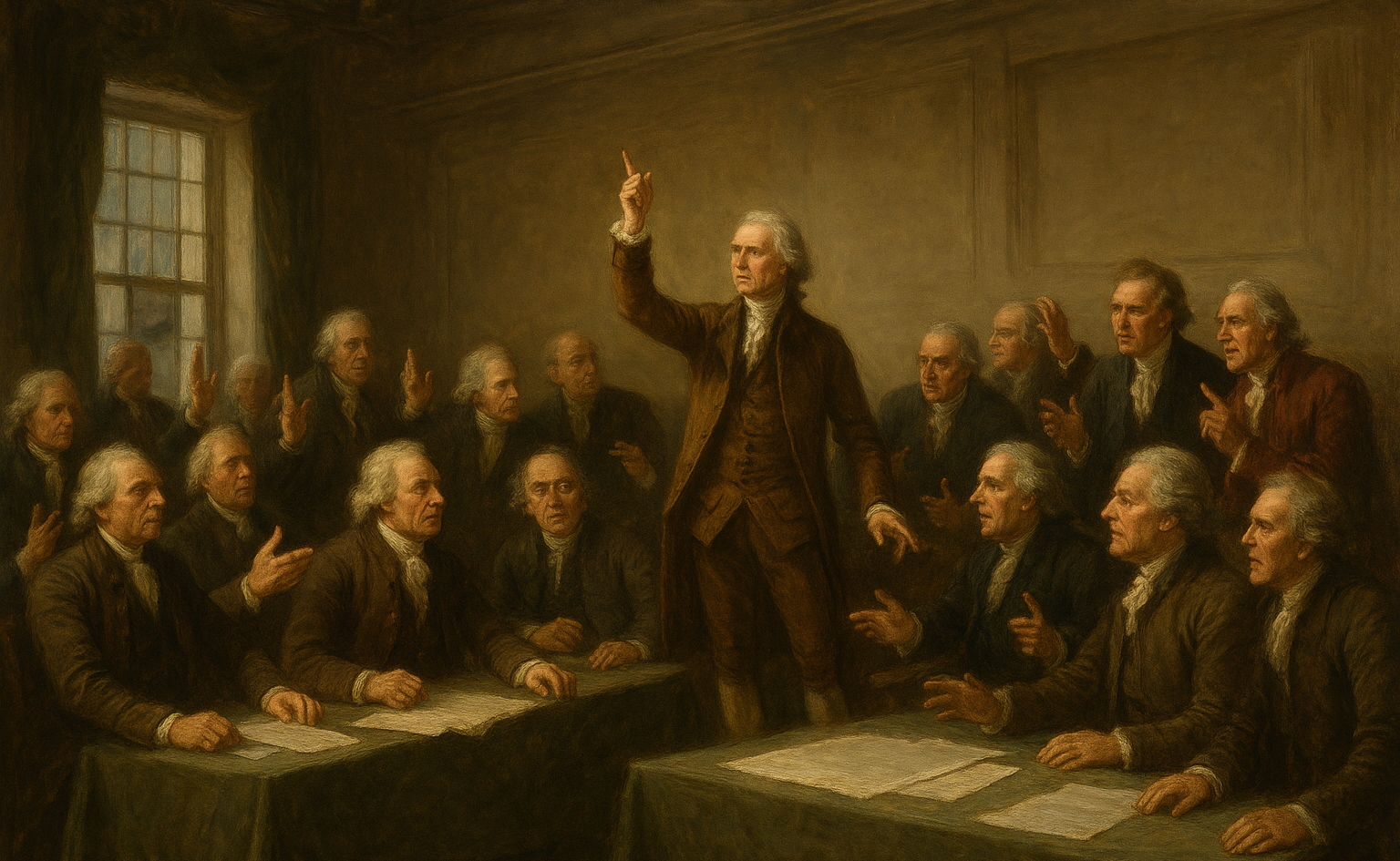
After four days of debate, Jefferson himself is reported to have struck the passage he had authored to gain the consensus of the Second Continental Congress. No kings was the goal, and a compromise had to be made to advance the cause of a democratic republic.
Crucially, the Constitution—drafted without Jefferson’s involvement, as his fellow Virginian James Madison was tasked with that responsibility—was ratified in 1788 and included a clause (Article I, Section 9, Clause 1) prohibiting Congress from banning the importation of enslaved people before 1808. This effectively created a twenty-year moratorium on ending the transatlantic slave trade.
One might condemn such a provision, but in truth, it reflects the intent of many of the Founders to eliminate the trade Jefferson had so forcefully denounced in the excised passage from the Declaration.
This, too, was a compromise meant to secure support from Southern states whose economies depended on slavery. However, once that period expired, Congress exercised its new authority, and, on January 1, 1808 (many Southerners having resigned themselves to the trade’s fate, since the Constitution had been ratified with that understanding twenty years earlier), the Act Prohibiting Importation of Slaves took effect, officially ending the legal importation of enslaved Africans into the United States.
Thus, we see that the institution of slavery—imposed on the New World by Britain—was opposed by many of the colonists, and now Americans, including some who themselves owned slaves. This puts the lie to the claim that America established slavery rather than inherited it. The truth is that the global slave trade was the prevailing order before America took steps to abolish it.
It is noteworthy that this action closely followed a similar measure by Britain—the Abolition of the Slave Trade Act—which took effect on March 25, 1807, less than a year before the US act did.
Let history record these facts, so often omitted from its teaching for ideological reasons: that the United States and Britain abolished their participation in the transatlantic slave trade within roughly the same year, reflecting a growing transatlantic movement against the trade and inspiring further efforts to abolish it everywhere in the Western world.
Slavery, unfortunately, continues in other parts of the world. Yet these regions are rarely the target of progressive condemnation. Instead, many ideologues seem more intent on erasing the United States’ role in ending the vile trade in human beings. It is an unfortunate reality that such ideologues have colonized our sense-making institutions and acquired the power of what has become, in effect, an Orwellian Ministry of Truth. The acts of a nation that should be credited with are used, through warping or omission, to tarnish a republic founded on the liberty of all individuals regardless of race.

 freedom and reason