
I seek no laws or ordinances forbidding the wearing of pants by women. So why would I seek rules telling men they cannot wear skirts? People can wear whatever they want—if what they wear is not a disguise to evade detection in the commission of a crime. What I will not abide by are laws and policies telling me that I must believe or speak in ways that affirm lies. A free society cannot tolerate rules that punish people for telling the truth or refusing to tell falsehoods. If we lose this shared understanding, then freedom dies.
In early 2025, in Washington State, Frances Staudt, a fifteen-year-old junior varsity basketball player, refused to play against an eighteen-year-old male athlete on an opposing girls’ team. The dispute occurred within the Tumwater School District, where athletic programs are governed by the Washington Interscholastic Activities Association (WIAA). Under WIAA policy, students may participate on sports teams consistent with their “gender identity,” regardless of their gender (or sex), without the need for legal or medical documentation. Not that legal or medical documentation should have any relevance, but I want readers to reflect on the fact that a male can merely say he is a female and play against girls in women’s sports. That’s all it takes: a male telling a lie about his gender. District administrators and the WIAA will valorize gender identity doctrine and discipline those who dissent from it.
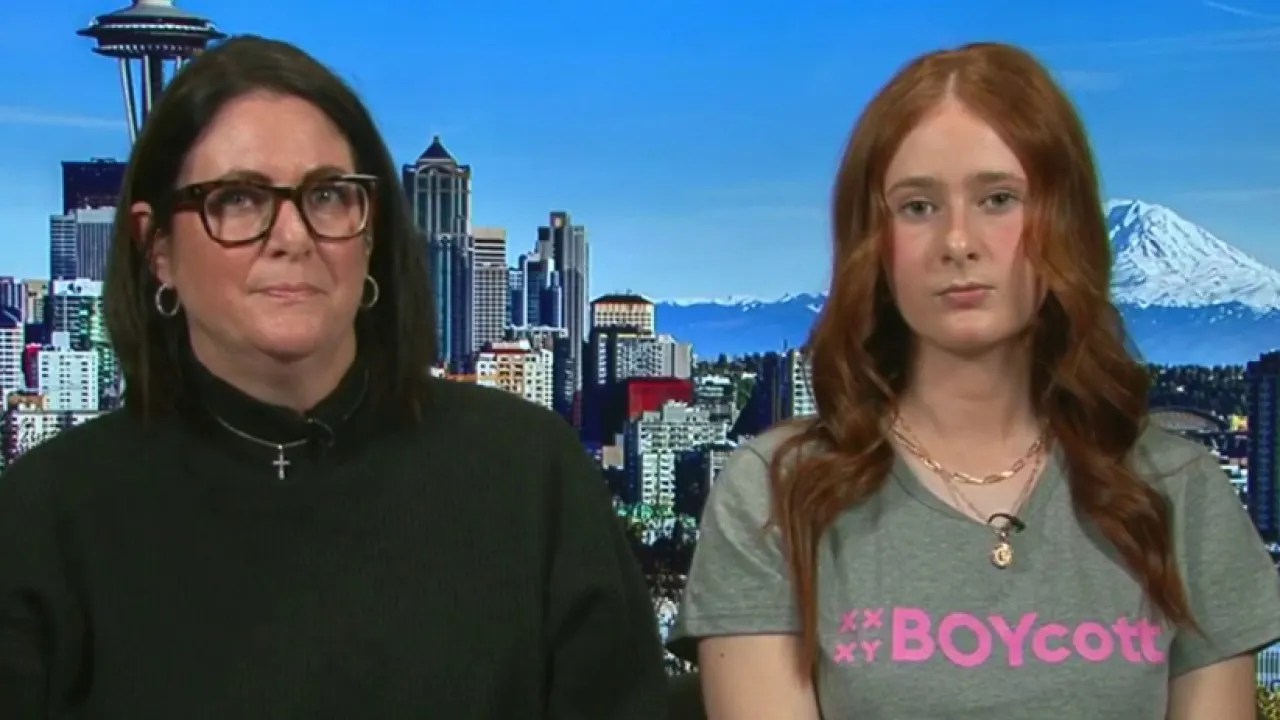
According to Staudt’s mother, she and her daughter were surprised to discover that a male player was competing on a girls’ junior varsity team (composed mostly of fourteen- and fifteen-year-olds). Concerned about fairness and safety, the mother approached the athletic director for clarification. She raised the matter of Trump’s executive order banning the practice of allowing males to compete against females in women’s sports. She was told that the district does not discriminate based on “gender identity” and that its policies were aligned with Washington State law, not federal directives.
Staudt chose not to play in the game. As she left the court, she reportedly muttered, “You’re a man” toward the opposing athlete—an impulsive remark, she says, made in anger rather than ill will. But what does the intent of her remark matter? People don’t have the right to make expressions of ill will in Washington State? Her remark did not disrupt anything except perhaps the delusions of the male athlete. She said it once, so it couldn’t possibly stand as a case of harassment. She’s a teenage girl, the male is an adult, so intimidation is out of the question. Stating “You’re a man” to a man is not a true threat. It is simply an acknowledgment of the truth.
Yet the moment sparked a disciplinary investigation, the district accusing Staudt of violating its “anti-bullying, harassment, and intimidation” policy by “misgendering” the transgender athlete. As I have explained on this platform, misgendering is when you, either accidentally or intentionally, call a person by the gender they are not. In this case, the girl acknowledged the gender of the male athlete; therefore, by definition, she did not misgender him. However, in the district’s view, which has adopted the rules of gender identity doctrine, the comment constituted harassment based on “gender identity,” a protected category under state law. I want readers to reflect on this: Washington State has made lying about one’s gender a protected category, while authorizing the thought police of a neoreligion to discipline those who tell the truth.
When I say truth, I am not offering an opinion but observing a trio of straightforward scientific facts, among the most fundamental truths of mammalian biology: gender is objective, binary, and immutable. Gender is not a subjective matter that becomes reality because public authorities claim it as such. Gender is not spoken into existence. Gender describes reproductive anatomy, which exists independently of language. It is either one or the other—even if the outward appearance of the individual is deceptive. One either acknowledges it or deceives oneself or others about it.
The Staudt family rightly and strenuously objected to the situation, arguing that Frances was being punished for expressing discomfort with a situation she—and anybody else with a just and rational mind—perceived as unfair and unsafe. They claimed that her speech—however blunt—was constitutionally protected and that the school’s action violated her rights under Title IX and the First Amendment.
How could the school not have violated her rights? Title IX is a 1972 federal law prohibiting sex-based discrimination in any educational activity or program receiving federal funding. It protects staff and students from discrimination based on sex, guaranteeing equal opportunity in academics and athletics. Moreover, the First Amendment ensures that no public institution or program can make law or policy restricting freedom of conscience or expression except where speech acts are used to disrupt the free speech rights of others, represent an imminent threat of violence, or defame another (a civil matter requiring the defendant to have made demonstrably false statements about a plaintiff with the intent to harm his reputation).
Trump’s Department of Education’s Office for Civil Rights (DoE/OCR) subsequently opened a Title IX investigation into the Tumwater School District. The federal inquiry seeks to determine whether the district’s handling of the case discriminated against Staudt based on sex or expression. At issue is whether the school’s actions reflect compelled ideological conformity—that is, students being forced to affirm beliefs about gender that conflict with biological and moral convictions. That this happened is obvious, and I applaud the DoE/OCR for moving aggressively on this case.
Those who support the inclusion of males in female sports maintain that protecting “transgender students” from verbal harassment is an essential application of civil rights law. But there is nothing in civil rights law warranting such a claim. I ask for the reader’s patience while I get into the weeds on this. Not only does it help with understanding the case, but it also demonstrates how elections matter to preserving the Republic and its core principles.
Title IX of the Education Amendments of 1972 was enacted to ensure equal opportunities for girls and women, particularly in athletics. Its framers understood sex as biological (what else would it be?). Yet in recent years, federal authorities have broadened Title IX’s interpretation to include “gender identity,” Bob Stoller’s (unfalsifiable) notion that one’s internal sense of gender is incongruent with their gender observed at birth, effectively redefining who qualifies as “female” in athletic competition. Washington State’s own civil rights laws go further still, explicitly prohibiting “discrimination” based on “gender identity” (or “gender expression”).
How did politicians in Washington State come to believe they are permitted to violate Title IX? It was a sleight of hand by the Democrats. In June 2021, Biden’s DoE announced that it would enforce Title IX’s protections against sex discrimination to cover discrimination based on “gender identity” and sexual orientation, relying on the Supreme Court’s 2020 decision in Bostock v Clayton County, which interpreted “sex” in the context of employment law under Title VII, which I will explain in a moment. In April 2024, the DoE issued updated Title IX regulations reaffirming that position, stating explicitly that discrimination based on “gender identity” constitutes “sex discrimination.”
Bostock v Clayton County involved Title VII of the Civil Rights Act of 1964, which prohibits employment discrimination based on sex. In a 6-3 decision, penned by Justice Neil Gorsuch, the Court consolidated three cases in which, upon learning that employees were gay or transgender, employers terminated their employment. The reasoning of the majority was that discrimination based on sexual orientation or “gender identity” necessarily involves treating someone differently because of their sex.
On the matter of sexual orientation, the decision makes sense. For example, if an employer fires a man for being attracted to men, but wouldn’t fire a woman for being attracted to men, sex is a but-for cause of the decision. However, the “gender identity” piece does not follow. The Court argued that firing someone for being “transgender” means penalizing them for their gender identity not matching the sex assigned at birth, thus constituting a form of “sex-based discrimination.” This assumes as valid gender identity doctrine while dismissing out of hand the reasons why an employer might have cause to believe that a man pretending to be a woman creates an unsafe working environment for customers and other employees. An employer dismissing a man pretending to be a woman is not discriminating on the basis of gender, but on the basis of the man’s deceit or delusion. If he is to be protected from termination for identifying as a woman, then the Court needs to leverage other law and precedent, not Title VII. (I leave it up to the reader to consider how the Court can accomplish this.)
While Bostock directly interpreted Title VII (employment law), however fallaciously, Title IX (education law) uses similar wording, since it bans discrimination “on the basis of sex” in federally funded education programs. Federal agencies under Biden leveraged this superficial similarity to extend protections under Title IX to “gender identity” in schools, including athletics, disciplinary matters, and restrooms. In a blatant disregard of reason and statute, they forced through an education policy that harms and discriminates against girls and women.
Stretching Bostock’s logic from Title VII to Title IX is not a bridge too far; it contradicts the principle of sex segregation in sports and other areas of public life as dictated by Title IX. Title IX, though it bans discrimination on the basis of sex, differs fundamentally in context, history, and structure from Title VII. Bostock’s reasoning, derived in the employment context, does not logically carry over to educational settings or to unique programs therein—athletics, privacy, or sex-separation issues. Indeed, Title IX expressly contemplates single-sex educational programs and athletics—it presumes sex segregation in sports and empowers authorities to maintain separate sports for females and males—in ways that Title VII does not. The presence of special carveouts or permissive provisions for differential treatment or separation based on sex is evidence that Congress intended distinctions by sex. That’s the point of Title IX!
In light of the Supreme Court’s ruling in June 2024 in the case of Loper Bright Enterprises v Raimondo, which overturned the long-standing Chevron deference doctrine, Title IX’s implementing regulations crafted by Biden’s DoE/OCR, relying on Bostock as a basis for interpreting Title IX, involves an impermissible agency overreach, especially when the ruling holds that courts should not give deference to interpretations that go beyond the statutory language. After all, Title IX is hardly an ambiguous statute. Moreover, the decision in Bostock is expressly confined to Title VII and employment decisions; it does not address educational institutions, athletics, bathrooms, locker rooms, privacy rights, etc. Applying Bostock to Title IX is an analogical leap lacking any grounding in precedent or statutory language. Extending Bostock to Title IX thus upends longstanding practices around sex-separated facilities, rules, and teams in educational activities and institutions, thus conflicting with other regulatory, statutory, and constitutional principles—e.g., bodily privacy and equal protection.
It’s not as if the Supreme Court has not addressed this issue in the meantime. In Department of Education v Louisiana(2024), the Court declined to allow enforcement of the Biden Administration’s new Title IX rule, which included expanded definitions of sex, leaving in place injunctions against those provisions. The Court’s stay implicitly recognizes that lower courts have reasonably found merit in claims against the rule’s “gender identity” provisions. So, mustering as much charity as possible in this case, appealing to Bostock as a persuasive authority on Title IX matters at the very best jumps the gun. (Do we have any doubt in how the Court will rule if the substance of this or similar cases comes before them?)
Thus, we have in the Washington State case a collision between state enforcement of “transgender inclusion” and federal efforts to preserve sex-based distinctions, especially in light of Trump’s executive order. When the athletic director told Frances’s mother that the district would follow state law, not federal directives, he was pitting the Democrats’ notion of state rights against federal supremacy in the governance of civil rights. Washington State is well out of its lane on this one. States cannot be allowed to dissent from federal statute or resist federal authority.
The First Amendment adds another layer. What are Staudt’s rights in light of the free speech rules of the Republic? Under the Supreme Court’s 1969 ruling in Tinker v Des Moines, students retain their right to free expression in school so long as their speech does not materially disrupt the educational environment or amount to a true threat. Whether Staudt’s comment constitutes harassment is the central question. As I already suggested, since she simply voiced a biological truth, the accusation that she targeted another student’s identity in a way that could reasonably cause harm is absurd on its face. If people are disciplined for expressing true statements because they hurt feelings, then conditions of unfreedom are obtained by coercive state power, illegitimately wielding that power.
This case is important because its ultimate resolution will carry national implications. If the OCR determines that the Tumwater district violated Staudt’s rights, it could set a precedent affirming sex-based protections under Title IX and limit the ability of schools across the nation to discipline students for gender-related speech. If the district is upheld, it will reinforce the authority of schools to enforce an Orwellian regime of “respectful language” policies and expand the scope of compelled affirmation of “gender identity” in public education. This would effectively render the First Amendment inert in the face of gender identity doctrine.
At the heart of the Staudt case lies a profound moral and social question: whether laws originally designed to protect girls and women are being reinterpreted in ways that redefine womanhood itself, over against the fundamental truths I earlier identified and at great detriment to girls and women. The debate is not simply about one student’s comment, but about the meaning of fairness and freedom in a pluralistic society. Frances Staudt’s experience illustrates how individual conscience and institutional policy are in direct conflict in the modern establishment of education and progressive ideology, determined by elite command of the educational system.
Thus, in the end, the Frances Staudt case represents more than a local dispute. It’s a microcosm of the broader struggle over equality, the protection of females, the protection of speech, and the attempt to infect biology with the ideology of queer politics. I have already made my views known on these matters, so I will briefly summarize them in concluding this essay:
True equality requires recognizing natural group differences, in this case, the inherent difference between females and males. Treating males as if they are females systematically disadvantages females and puts them in harm’s way.
Free speech, if it means anything, is the freedom to express opinions that hurt other people’s feelings. With obvious exceptions, we each have a right to be protected from harmful action, but do not enjoy a right to be protected from expressions of truth.
Finally, science must always trump ideology in the realm of law and policy—and in science itself. If it ever comes to pass that crackpot notions like “gender identity” stand as truth in education, law, and policy, we will live in a society determined by lies.
The state board and Tumwater Board have also pushed back. The Tumwater Board adopted a resolution backing a change to WIAA policy that would limit participation in girls’ sports to students whose biological sex is female. The Education Department is threatening to withhold federal money if Washington state continues to allow trans athletes on girls’ and women’s teams. Meanwhile, a federal judge has issued a temporary ruling that blocks this strategy — saying the Trump administration’s actions amount to executive overreach.
With regard to gender identity, the Trump Administration through DOE has largely rescinded or reversed the Biden-era interpretations under Title IX. It has reverted to enforcing the 2020 Title IX rule, which does not treat gender identity as a protected category, and the Biden 2024 rule that explicitly expanded Title IX protections to include gender identity has been struck down by a federal court and is no longer enforceable.

Why is Washington State being so recalcitrant? Washington State Superintendent of Public Instruction Chris Reykdal tells us why: “They want to take folks to court. They want high-profile cases. They’re not just trying to win a case—they’re trying to vilify trans youth and the schools that support them. What they’re really doing is taking on states’ rights.”
There it is. Just as with immigration and crime, progressive Democrats see gender identity doctrine as a battle in the civil war they are fomenting. This is the neoconfederate tendency that began as soon as the Confederacy was defeated by Union forces way back in the 1860s. Progressives are hiding their secessionist desires behind the false charge that conservatives are waging a cultural war against progressives.
Again, Reykdal: “The best thing to do is follow state law. And the best thing for the federal government to do is deal with the numerous problems they have right now, instead of crafting a cultural war against, arguably, five to ten kids on average per state.” One boy in girls’ sports is enough. It’s not about numbers. It’s about principle. It’s about civil rights.

 freedom and reason