
“I don’t like that this is a fact of life, but if you are a psycho and you want to make headlines, you realize that our schools are soft targets. And we have got to bolster security at our schools. We’ve got to bolster security so if a psycho wants to walk through the front door and kill a bunch of children, they’re not able.” —JD Vance, Vice-Presidential Candidate

One thing that needs to be said about the case of Colt Gray, the 14-year-old suspect in the Apalachee High School mass shooting (the deadliest school shooting in Georgia’s history), is that, if this were a trans identified shooter, instead of being fed moment-by-moment details of the case as it unfolds, the public would be denied details of the case and the media would stop reporting on the story. Recall the case of Audrey Hale, the trans man who perpetrated the 2023 Covenant School shooting in Nashville, Tennessee. Hale, a 28-year-old former student of the school shot and killed three students and three staff members before being fatally shot by police. Her writings are still being kept from the public and her case has been effectively memory-holed. If Gray has a manifesto, we will likely know about it and its contents (presuming he is not also trans identifying).
Update (7:10 pm): we have learned about things he has written. See this CNN story.
A second thing that needs to be said is that mass shootings by young white males are presented as typical when in fact most mass shootings are perpetrated by young males in black-majority inner-city neighborhoods (young black males commit most homicides in the United States, with most of their victims being other young black males). White males are made to be the poster boys for a crime type in which white males are underrepresented. This is not accidental; the elevation of cases like the Apalachee High School mass shooting, while other cases are downplayed, marks the propagandistic purposes of crime stories. What underpins this particular phenomenon is identity politics, the prevailing character of which is anti-white bias.
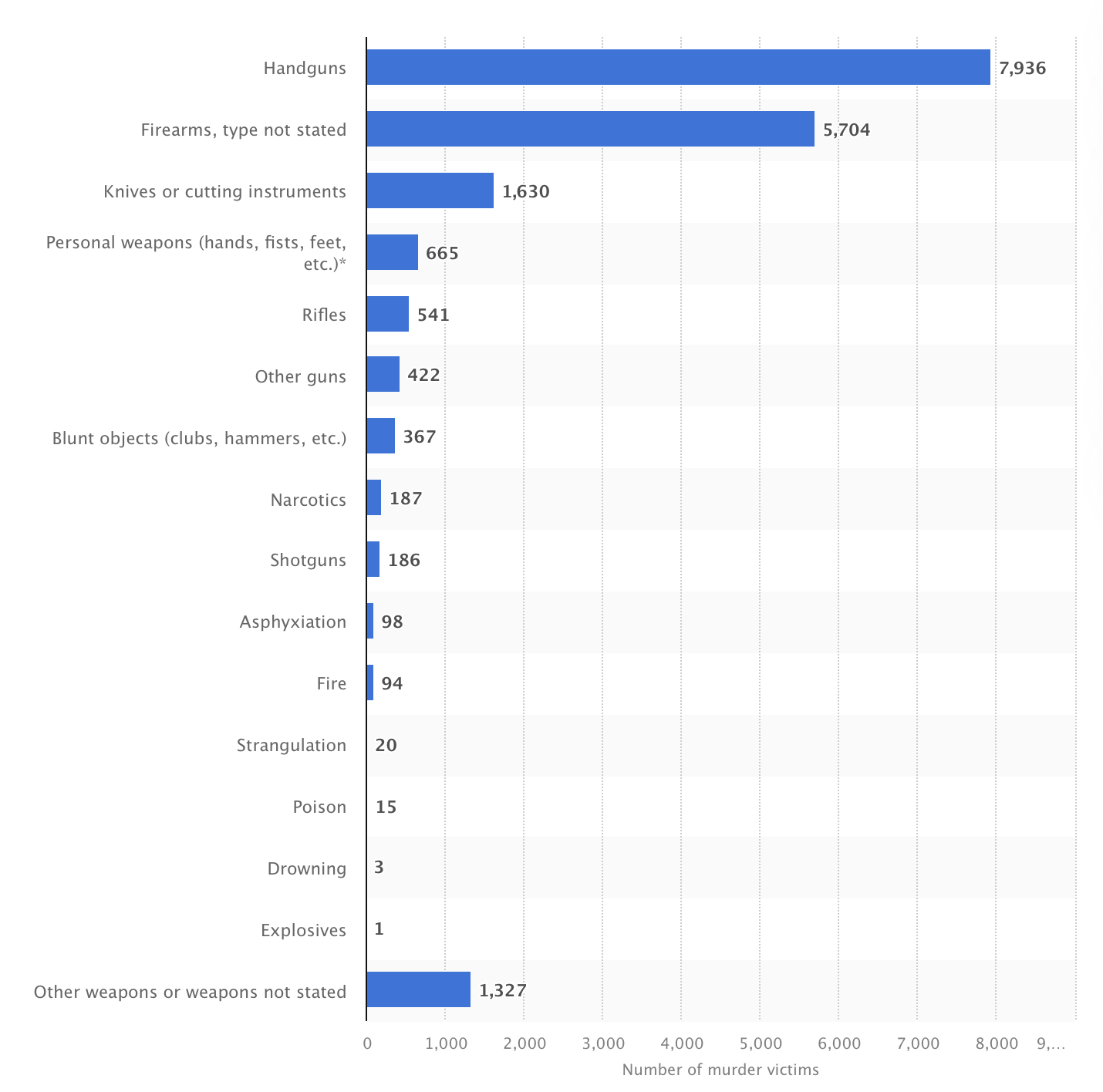
A third thing that needs to be said is that this and other recent cases of high-profile mass shootings are being used by Presidential candidate Kamala Harris and other Democrats to advance the cause of banning what they refer to as “assault weapons” or “AR-style rifles,” i.e., a particular type of rifle that has military applications. As the reader can see, the weapon of choice in murder (and this is true for suicide, as well) is the handgun. Of the 19,196 murders recorded for 2022, rifles were used to perpetrate 541 of them—fewer than were killed with personal weapons, i.e., hands, fists, feet, etc.—or 2.8 percent of murders. The reason the focus is on the so-called assault weapon is that elites believe military-style weapons are the most effective weapon in resisting government tyranny.

The fourth thing that needs to be noted, and this is what I want to focus on in this essay, is the disturbing trend in punishing a parent or parents for crimes perpetrated by their children. Recall the 2021 Oxford High School shooting in Michigan. The shooter, Ethan Crumbley, a 15-year-old student at the school, was convicted of murder in the deaths of four students and injuries to several others. In that case, the shooter’s parents, James and Jennifer Crumbley, were convicted of manslaughter for their role in the shooting and sentenced to ten to fifteen. What was their role? In sentencing the Crumbleys, Oakland County Circuit Court Judge Cheryl Matthews said James Crumbley provided “unfettered access to a gun or guns as well as ammunition in your home,” while Jennifer Crumbley “glorified the use and possession of these weapons.”
Millions of homes in the United States have unfettered access to guns and ammunition (as well as knives, clubs, poisons, etc.). In Michigan at the time Crumbley committed his crime there were no specific laws about the minimum age for possessing a firearm under parental supervision. Nor did Michigan have a specific law mandating safe storage of firearms in homes or any laws that directly addressed parental responsibility or liability for the misuse of firearms by minors in their home. The First Amendment protects a mother’s glorification of guns. The glorification of guns is part of American culture. That James and Jennifer Crumbley could be sent to prison for something they did not do, namely take a gun to school and shoot people, is an obvious case of misattribution of responsibility. Deranged by the desire for retribution, the state punished those who did not perpetrate the crime.
Colt Gray appeared in the Barrow County Courthouse in Georgia this morning for his arraignment alongside his father, Colin Gray. Judge Currie Mingledorff informed Colt that he could face life in prison if convicted of any of the four felony murder charges brought against him. Despite his age, Colt is being tried as an adult. Colt’s father was informed that he could face up to 180 years in prison. Colin faces charges including four counts of involuntary manslaughter, two counts of second-degree murder, and eight counts of cruelty to children. Colt is accused of using an AR-style rifle to open fire on students and staff at Apalachee High School in Winder, resulting in the deaths of two 14-year-old students and two teachers. The victims were students Mason Schermerhorn and Christian Angulo, as well as teachers Richard Aspinwall, 39, and Christina Irimie, 53.
Colin is alleged to have purchased the semi-automatic weapon as a Christmas gift for his son. As in the case of Crumbley, guns were a prominent feature of Gray’s home life. Last year, Georgia authorities visited the Gray residence after receiving an FBI tip about concerning messages posted on Discord, where Colt had allegedly made threats to “shoot up a middle school” and shared photos of firearms. Colin told investigators that there were guns at their home, but that his son did not have unauthorized access to them.
Georgia does not have universal background checks for gun purchases, safe storage laws, or so-called red-flag laws. As readers might imagine, there a lot of households in Georgia with lots of easily-accessible guns. Georgia law does prohibit an adult from “intentionally, knowingly, or recklessly” selling or giving a handgun to a minor. If convicted of that offense, the adult could face felony charges, which may result in prison time or a fine. However, there are exceptions to this rule. Minors may possess handguns if they are attending a hunting or firearms course, practicing on a shooting range, participating in a competition, or are at home with parental permission. These exceptions are not applicable if the minor has been convicted of a forcible felony, but Colt Gray has no convictions for forcible felonies to my knowledge. That Colin could possess guns and allow his son to use them is not a criminal offense.
In its coverage of the story, The New York Times has cited experts from the Johns Hopkins Center for Gun Violence Solutions who noted that the law’s lack of penalties for negligent storage and absence of safe storage requirements makes it less effective in reducing gun violence and firearm-related deaths among children. More than this, it makes it difficult to imagine how Colin Gray could be held responsible for the actions of his son. “Georgia’s law is not actually geared toward preventing unauthorized access of firearms by children—it’s instead focused on punishing adults who recklessly or intentionally give children handguns,” said Tim Carey, a law and policy adviser with the center. Perhaps the father can be punished for recklessly giving his so a firearm. But how does that translate into holding the father responsible for murder and putting him in prison for the rest of his natural born life?
I saw the case of James and Jennifer Crumbley as a warning sign that justice in the United States was regressing. Of course, the Crumbley case was an n=1. We now have two cases. A culture of personal responsibility underscores a fundamental principle: firearms themselves are neutral tools, their impact dependent solely on human action and intent. In communities where guns are an integral part of daily life, such as in Tennessee, the state in which I grew up, the emphasis is placed on the responsible handling and use of firearms rather than on the guns themselves as sources of violence. I grew up in a home with easy access to guns and the freedom to use those guns for legitimate purposes. It would be inconceivable then than my father would be held responsible for something I did with a firearm.
This cultural understanding acknowledges that while firearms are easily accessible, their use is governed by a deep-seated ethic of individual responsibility. The notion that “guns don’t shoot themselves,” which I find myself having to frequently remind people of, aligns with the belief that accountability lies with the person who wields the weapon. Accountability focuses on responsible gun ownership practices—safe storage, proper training, and adherence to safety protocols—rather than imposing broad restrictions that do not address the root causes of gun violence, or holding people responsible for the sins of others.
The presence of guns in the home is not inherently dangerous but rather that the potential for harm is mitigated through education and conscientious behavior. By fostering a culture of safety and respect for firearms, communities can maintain the freedoms associated with gun ownership while actively working to prevent misuse. This stance supports the idea that effective solutions to gun violence involve addressing behavioral issues and ensuring that responsible gun practices are upheld, rather than constraining access to firearms, which are a legitimate part of many people’s lives and traditions.
More broadly, and I have made this point in criticizing the fallacious logic of critical race theory, holding individuals accountable for the actions of others is ethically and morally problematic as it violates the fundamental principle of justice and personal responsibility. In enlightened legal and moral frameworks, responsibility should be directly linked to one’s own actions and intentions rather than being arbitrarily extended to others. Holding people accountable for the actions of others not only undermines the principle of fairness, but it also risks regressing to forms of justice reminiscent of primitive or collective forms of punishment, where individuals are held liable for acts they did not commit.
In modern, rational societies, justice is ideally grounded in individual accountability, ensuring that legal and moral responsibility is assigned based on direct involvement and intent. This approach reflects a rational form of justice wherein each person is judged by his own conduct. Whatever the parents of Ethan and Colt did, it cannot be murder. They neither pulled the trigger nor commanded their sons to shoot anyone. Ethan and Colt made the decision to take those guns to school and shoot those people. They are solely responsible for that decision. That both were charged as adults indicates the court’s understanding that they were mature enough to take on that responsibility and suffer the consequences of their actions.
I began this essay by quoting Vice-Presidential candidate JD Vance concerning the problem of schools as soft targets. I want to conclude by acknowledging that Vance is right and that my past criticisms of school resource officers (SROs) and target hardening were wrong. In a 2018 essay on Freedom and Reason, The Garrisoning of Our Schools, I summarized my ideas and linked to two op-eds I had recently penned, one published in the Green Bay Press Gazette (“Police in schools does not make them safer”) and another for TruthOut (“How Garrisoning Schools with Armed Resource Officers Normalizes Authoritarianism”). I was rightly thumped by those who took the time to critically respond to those columns.
In the TruthOut essay I wrote “Cops in schools neither makes schools safe nor facilitates education. The socialization of danger fosters a sense of insecurity and hopelessness, a mood on which authoritarianism thrives.” Yet, if it has not been for two SROs at Apalachee High School, Brandon King and Donovan Boyd, there would likely be more dead and injured students, staff, and teachers. Gray “was armed, an SRO engaged him, and the shooter quickly realized if he didn’t give up this would end with an officer-involved shooting,” said Barrow County Sheriff Jud Smith. Deputies and SROs were on scene within minutes after the incident was reported. “He got on the ground and a deputy took him into custody.”
Public safety is a human right. Children deserve to be safe in school. Their parents should have the peace of mind that schools are doing everything they can to keep their children safe. In light of the level of violence in our society, making schools safe will involve measures I have criticized in my past essays. Moreover, evidence indicating the deterrent effect of police presence suggests policies that put more police on our streets. Increased patrols lead to reductions in crime rates; the presence of police enhances the perceived risk of arrest. Just as I changed my mind about the systemic racism underpinning lethal civilian-police encounters when confronted with facts, so I must change my mind in light of these cases and announce that change of mind.

 freedom and reason