
I haven’t worked out the math in great detail, but the Prometheus (the starship in Ridley Scott’s movie Prometheus) does not need to travel faster than light to reach its destination in a few years. This is satisfying because we can remain in the realm of conventional physics. In fact, it only works out if we do.
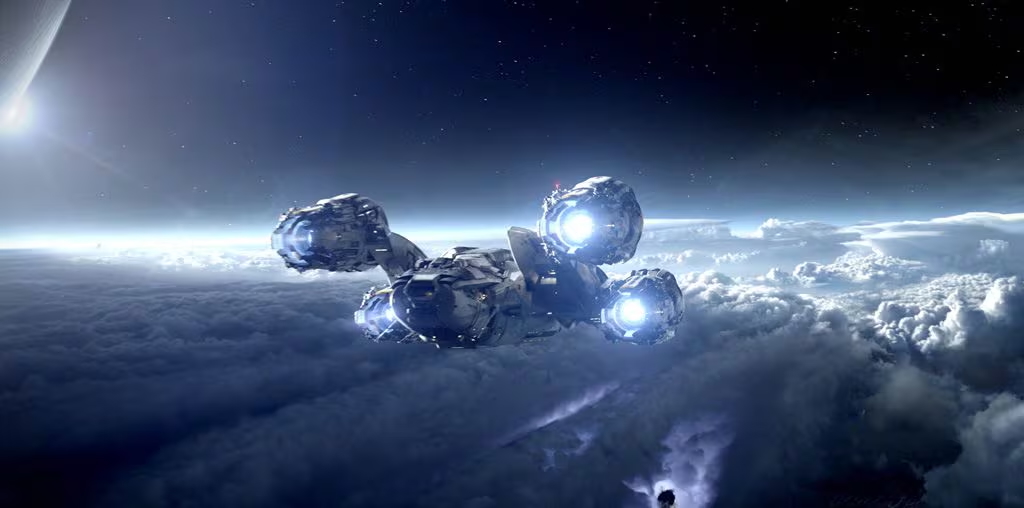
The planet LV-223 is in the Zeta 2 Reticuli star system, which is approximately 12 parsecs from Earth or 39 light years. (This is a real place, in case you were wondering.) The movie gives a different distance: 34.5 light years. Perhaps this could be accounted for by distances between the stars in Zeta 2 Reticuli, with LV-223 on the near side of the system relative to us (I am not an astronomer, I don’t know the distances, so I’m speculating). At any rate, given our frame of reference here on Earth, the Prometheus would reach LV-223 in 34.5 years at light speed, a little bit longer at near-light speed.
According to David, the humans were in cryonic sleep for 2.4 years. This is what is referred to as “ship years.” We can explain this using the concept of time dilation (theory of relativity), which has the Prometheus traveling somewhere in the neighborhood of .99 percent light speed. At this speed, the Prometheus could do a round trip in 4.8 ship years, which would be experienced by the crew as a normal 4.8 years.
Time elapsed on Earth would be 69 years, which is the current average lifespan of a person. I suspect life has been extended by 2089, the year Shaw and Holloway discover the ancient star map, but not by that much.
The Prometheus arrives at LV-223 in the year 2093 relative to their frame of reference. From the relative frame of a person on Earth, supposing the Prometheus left in 2090, the ship would arrive at LV-223 in the year 2114. If the crew had survived and returned to Earth, they would arrive home in 2159. By then everybody they had known would be deceased.
This means that the Engineers’ Juggernaut, assuming it couldn’t defy the known laws of physics, would have reached the Earth in 34.5 years. It is possible for the Prometheus to have sent a message on a beam of light to that would have arrived a few weeks or months before the juggernaut arrived warning Earth of its arrival. That might have been enough time to prepare, especially given the level of technological prowess; they should have the technology to deal with the alien vessel.
The Prometheus could also have taken off and raced the Juggernaut back to Earth sending warnings the whole way. But it was hectic and all, and the Juggernaut did get the jump on them. Moreover, it might have been armed and whacked the Prometheus.
(As an aside, had the ship left when it was supposed to, and safely arrived on schedule, the apocalypse promised by the Juggernaut’s cargo would have hit Earth 2000 years ago and the history of our planet would likely have been radically altered.)
I think that some folks are trying to calculate the matter in the following way: Assume two positions in space separated by 35 light years: location A and location B. Assume, for the sake of the illustration, equivalent gravitational pulls, etc., at these locations. Time is thus roughly equivalent. Now launch a ship from location A to location B. The ship will travel at multiple times the speed of light in order to reach its destination in two years. The speed of light is 670,615,200 miles per hour. A light year (the distance light travels in a vacuum in a year) is 5,865,696,000,000 miles. So the distance from location A to location B is 205,299,360,000,000. That’s a bit more than 205 trillion miles. How fast would you have to be traveling to make that journey in two years (ignorant of time dilation)? I can make it there in 2.1875 years at a speed of 10,729,843,200 miles per hour. That is five times the speed of light.
Now, throwing time dilation into the mix, and working through the Lorentz transformations (which I haven’t used since I was a teenager, so I’m not even going to try it), the time experienced by the crew of the Prometheus will be less than two years. How much less, I don’t know for sure, but considerably less. However, this is impossible, since nothing can travel faster than the speed of light.

 freedom and reason